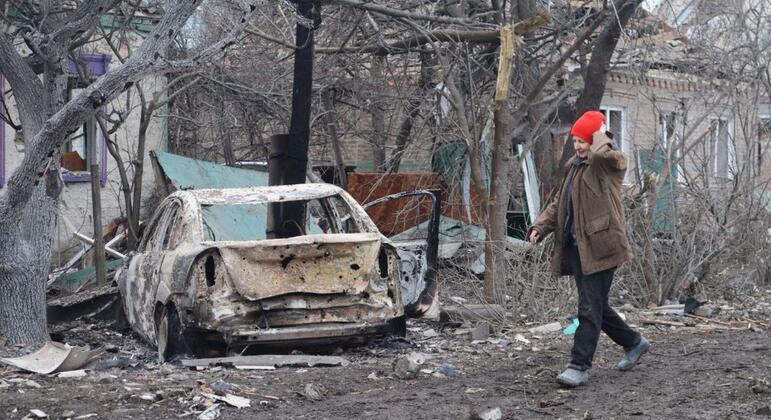
“During the first two months of this year, 60 per cent of all civilian casualties were in frontline regions (and) almost half of those killed were older persons,” said Deputy High Commissioner for Human Rights, Nada Al-Nashif.
In a scheduled update on the war to the Human Rights Council in Geneva, Ms. Al-Nashif noted that the leading cause of death and injury was “attacks involving short-range drones” in both Ukrainian government-controlled areas and territory occupied by Russia.
UN data shows that in 2025, at least 580 civilians were killed and 3,000 injured in such attacks. But in just the first two months of this year, 107 civilians were killed and 430 injured, representing a near-doubling of the casualty rate.
A full 95 per cent of casualties were caused by short-range drones targeting Government-controlled territory, the Deputy High Commissioner added.
Frontline victims
Danger is ever-present in frontline areas occupied by Russia too, including Oleshky district in Kherson region, where residents describe “frequent drone attacks”, ambassadors heard.
“Together with landmines along roads… evacuation (is) extremely difficult and dangerous, leaving many people trapped close to the frontline,” Ms. Al-Nashif maintained, describing food shortages and other critical humanitarian needs.
Turning to repeated attacks by Russian forces on Ukraine’s energy infrastructure, the Deputy High Commissioner noted that these have intensified this winter, “including strikes on systems that heat residential buildings, causing severe hardship for civilians”.
Today, Ukraine has lost more than half its capacity to generate electricity, causing power outages across the country “of up to 22 hours a day in some areas”, Ms. Al-Nashif explained.
“Hundreds of thousands of civilians were left without heating, some for weeks and even months, in temperatures that often fell below minus 15°C,” she continued, before citing reports that could not be confirmed of attacks on energy facilities in Russian-controlled areas, too.
Echoing those concerns, the UN Children’s Fund, UNICEF, warned that youngsters have endured “the toughest winter” of the war so far, caused by attacks on energy and water infrastructure that have disrupted electricity, heating and water and sanitation amid freezing temperatures.
“Children lost an estimated 79 to 88 per cent of effective learning time between mid-January and mid-February,” said the agency’s Anne Grandjean, Programme Specialist.
Plight of captured soldiers
The Deputy High Commissioner also highlighted longstanding concerns of Russia’s “widespread” and continuing ill-treatment of captured soldiers.
“Over 96 per cent of the Ukrainian prisoners of war that we interviewed said they were subjected to torture and ill-treatment during their captivity” since Russia’s full-scale invasion in February 2022, Ms. Al-Nashif explained.
In a call to Russia “to stop this war”, the senior UN human rights official also urged Moscow to “halt extrajudicial executions, torture, ill-treatment and other violations against prisoners of war and civilian detainees…In short, to meet in full their obligations under international law”.
The Deputy High Commissioner also called on Ukraine “to safeguard prisoners of war from torture and ill-treatment” and end discrimination against people often left with no choice but to leave territory occupied by Russia.
Right to reply
Responding to those comments, Ukraine’s Permanent Representative to the UN in Geneva, Yevhenii Tsymbaliuk, underscored the widespread impact of the war in uprooting thousands of civilians in Donetsk, Luhansk, Kherson, Zaporizhzhia and Crimea – “a deliberate strategy by Russia to terrorise civilians, suppress dissent and punish those who refuse to abandon their homes or comply with Russia’s illegal policies”.
Dismissing the UN Deputy High Commissioner’s update on the war, the Russian delegation urged her to “stop upholding the Kyiv regime” alleging a “war on dissenters, bloggers, journalists, enemies of Zelensky”.
Many of the UN Human Rights Council’s 47 Member States also spoke at the oral update on the Ukraine war, which has been a regular feature of its work since Russia’s illegal annexation of Crimea in 2014.
“We are appalled by Russia’s increased targeting of civilian life, instilling fear and trauma,” Germany’s delegation said. “Widespread and systematic missile and drone attacks have killed and injured ever more civilians in recent months.”
Taking the floor, China’s delegation stressed its country’s commitment “to promoting talks for peace and advancing political settlement of the Ukraine crisis”.