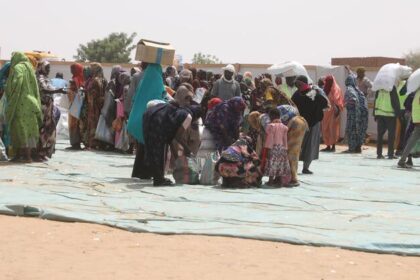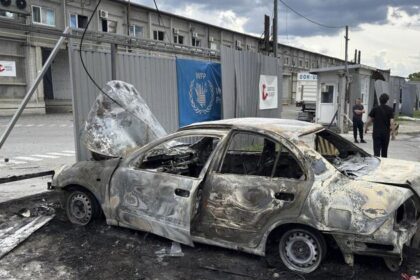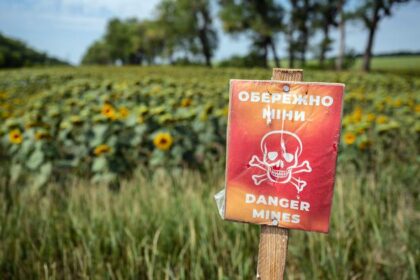


Hundreds of thousands in Afghanistan are grappling with hunger and poverty, facing a crisis exacerbated by frequent floods, earthquakes, dwindling humanitarian funding, and border closures.
Logistical Challenges and Obstacles
For many Afghan students, nutrient-rich biscuits distributed by the World Food Programme (WFP) represent their most nutritious meal of the day. However, delivering this vital aid into the country involves an intricate logistical undertaking.
A shipment of 397 metric tons of nutritious food, intended for approximately 172,000 students and dispatched from Surabaya, Indonesia, is part of a $3.5 million contribution from the Indonesian government to support WFP’s school meal programs.
Initially, the aid reaches Pakistan’s southern port of Karachi by sea. Beyond this point, the process becomes significantly more challenging.
The plan was to transfer the shipment to trucks for a 7,000 km journey through Pakistan. However, border closures due to escalating tensions between Pakistan and Afghanistan halted this route.
Hunger Cannot Wait
As WFP Director of Supply Chain and Delivery, Corinne Fleischer, emphasized, “hunger does not wait for routes to reopen.” This necessitates the urgent identification of an alternative path.
WFP shipping officials conceived a new plan: rerouting the cargo to Jebel Ali port in Dubai, transiting across the Gulf of Oman, entering Iran, and then proceeding overland to Afghanistan.
However, geopolitical factors, including instability spreading across the Middle East and the de facto closure of the critical Strait of Hormuz since March, have once again compelled WFP to re-evaluate its strategy.
Logistics experts at WFP’s operations centers have returned to fundamental principles, poring over maps to determine if the region’s geography could offer a viable solution.
They identified a completely new land corridor: a route stretching from Dubai across the Caspian Sea to the Caucasus. While this route is more expensive, complex, and adds an additional 8,000 km to the journey, it emerged as the only remaining option.
New Route, New Hope
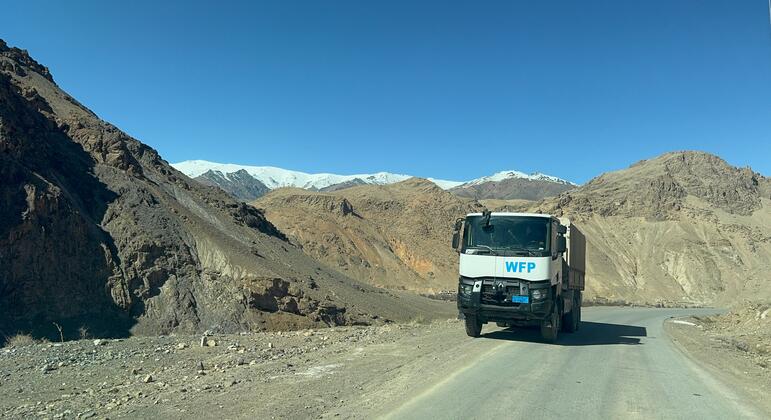
On a cloudy, overcast morning, a convoy of 21 trucks departed from Dubai. They traversed desert highways through the United Arab Emirates and Saudi Arabia, continuing through Jordan, Syria, and Turkey, eventually reaching Georgia. From there, they boarded a ferry in Baku, Azerbaijan, to cross the Caspian Sea and arrive in Turkmenistan.
Days later, the trucks entered Afghanistan via the Torghundi border crossing, proceeding towards Kabul. Each country the convoy passed through required new customs clearances, security assessments, transport permits, and coordination at seven borders.
Along the route, truck drivers faced prolonged waits at border crossings, signed paperwork, and rested under the open sky.
Hüseyin Sarraç Ulus, a Turkish truck driver who covered approximately 3,000 km from Dubai to the Caspian Sea, recalled, “I remember the ferry at the Baku Alat port where hundreds of trucks were waiting, with queues stretching almost 30 km.”
Working Day and Night
Ulus shared, “We drove for about 11 hours a day, often sleeping in the truck cabin at night. It wasn’t always comfortable, but we were used to it. We ate simple meals like soup, bread, rice, and tea. But it felt good. Knowing the cargo was helping children made me proud to be part of the journey.”
At a World Food Programme (WFP) warehouse on the outskirts of Kabul, Abdul Ahad Monib watched as the trucks slowly backed into the unloading bays.
Mr. Monib, a WFP Supply Chain and Delivery Officer, stated, “We felt a great sense of relief when we saw the trucks arriving. We closely monitored every step of the journey: every delay, every border crossing, every change of plan.”
After weeks of travel, the biscuits finally reached the hands of boys and girls in schools across the Ghor, Nuristan, and Paktika provinces in central, northeastern, and eastern Afghanistan.
Monib added, “For the children, it’s a pack of biscuits that helps them stay healthy. For us, it’s a logistical success. The thousands of kilometers, the delays, or the rerouting behind each pack go unseen by anyone. But that’s what truly matters – no matter the obstacles, WFP delivers.”