


Since its origins in the late 19th century, jazz has served as a potent instrument for social transformation, challenging racial segregation, advocating for equality, and fostering cross-cultural understanding. This enduring art form, born from the American melting pot, continues to resonate in the 21st century, retaining its capacity for social commentary and activism.
Sullivan Fortner, a three-time Grammy-winning jazz pianist, emphasized jazz’s intrinsic connection to freedom, America, humanity, and love in an interview with UN News at the Village Vanguard jazz club in New York. “As long as artists continue to create it, it will always be relevant to the times that we live in,” Fortner stated ahead of International Jazz Day on April 30th.
The annual celebration of jazz underscores its role as a universal language of freedom, creativity, and peace. It offers a platform to cultivate greater appreciation for the music and its contribution to building more inclusive societies. “It’s [about] emotional transmission and communicating those emotions and those feelings to each other. Jazz is 100 per cent about that, about the good, the bad and the ugly all in one,” Fortner explained.
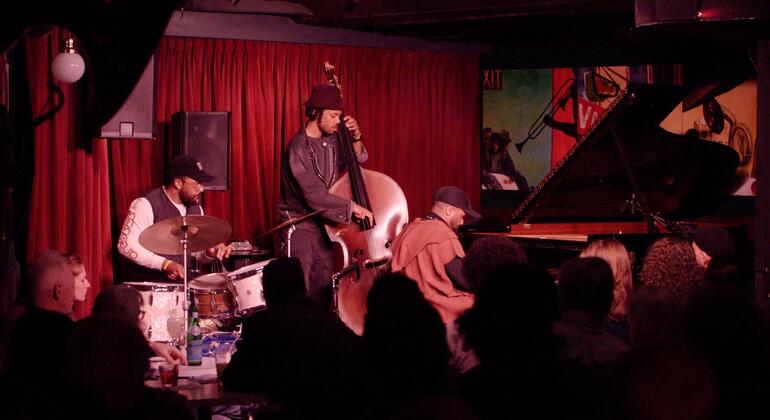
The Village Vanguard, a legendary jazz club in lower Manhattan, is considered a true embodiment of jazz’s rich heritage. Descending into its intimate, unchanged triangular room, one is transported into a space where jazz feels both timeless and vibrantly alive.
From Poets to Trumpets: A Historic Venue
The Village Vanguard, with its iconic red doors, leads to a low-ceilinged room that has preserved its atmosphere for decades. The stage is set with a double bass, a Steinway piano, and a drum kit, facing rows of antique tables and chairs adorned with pictures of legendary performers like Miles Davis and John Coltrane. Owner Deborah Gordon notes, “We try to keep it very simple here.” However, when artists like the Sullivan Fortner Trio perform, the space transcends nostalgia, becoming a dynamic hub of improvisation and unpredictable musical exploration.
Unity Through Jazz: The Village Vanguard’s Legacy
Originally a venue for diverse artists including poets, calypso dancers, and folk singers, the Village Vanguard became exclusively a jazz club in 1957, aiming to provide a unique platform for cultural and political expression through music. Gordon observes that jazz, while sometimes a fringe or specialized genre, draws a diverse audience, a mix of seasoned enthusiasts and younger generations.
Melodies and Messages: The Uniting Force
During performances at the Village Vanguard, an energetic connection flows between the stage and the audience. Gordon describes it as a circular energy exchange, highlighting the uniting power of music. This unifying force has historically empowered marginalized Black communities, particularly in New Orleans, where jazz originated as an act of protest and artistic rebellion.
Evolution and Revolution: Jazz’s Enduring Message
Fortner states, “The way the music started was out of sheer protest… we were birthed out of a rebellion of artists trying to take a stance.” He notes that artists like Billie Holiday used jazz to protest racial injustice and promote integration, making it a soundtrack to the Civil Rights Movement. Today, jazz continues to evolve, incorporating diverse musical influences. “Jazz is beyond notes and rhythms. It’s language. It’s the way people speak. It’s the way people gesture to one another,” Fortner adds, emphasizing its continued capacity for social commentary and activism.
We have to remember that this is street music and that it has to be accessible to people who may not necessarily have shoes
Remembering the Streets: Jazz’s Roots
While jazz is often perceived as a high-art form, musicians stress the importance of remembering its origins. “Sometimes we’ve gotten so intellectually profound that we forgot to reach and take the gutter with us. I feel like we can’t forget that this was birthed in the streets, that it was birthed in brothels,” Fortner shared. He concludes, “We have to remember that this is street music and that it has to be accessible to people who may not necessarily have shoes. We have to remember that and take those people with us whenever we perform or whatever we play.”