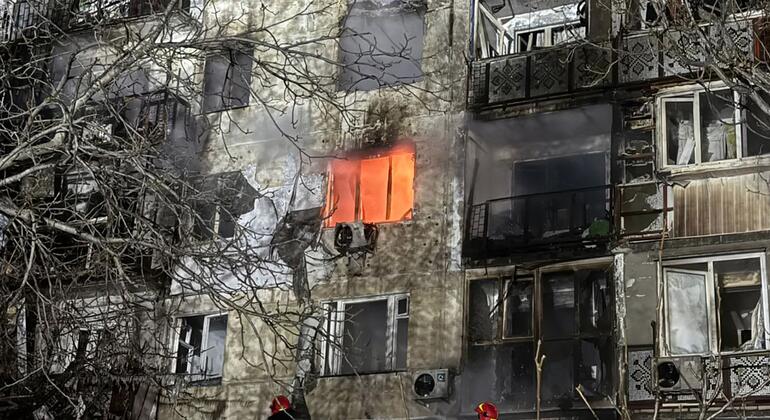
According to the Office for the Coordination of Humanitarian Affairs (OCHA), since 26 December, attacks nationwide also caused widespread damage to civilian infrastructure, leaving parts of the country without electricity, heating and water, as temperatures drop below zero.
Across the country, authorities reported nearly 100 civilian casualties during this period.
The most severe consequences were reported in Kyiv City, where a large-scale attack on 27 December killed and injured several people. Energy facilities, residential buildings, a preschool, a university dormitory, civilian vehicles, shops and other civilian premises were damaged.
No heating in winter
OCHA cited an energy company reporting that more than one million homes in and around Kyiv lost power following the strikes. Water supply was disrupted and roughly one third of the capital’s population was left without heating at the height of winter.
The same wave of attacks affected the regions of Chernihiv, Dnipro, Donetsk, Kharkiv, Kherson, Sumy and Odesa, causing further casualties, and damaging homes, education facilities and infrastructure.
Electricity has since been restored to nearly 750,000 households in Kyiv and almost 350,000 households across the surrounding Kyivska region. However, heating and electricity remain disrupted by emergency and scheduled power outages.
Humanitarian partners have set up warming tents where residents can seek shelter, receive food, charge mobile phones and access basic assistance.
Essential services under threat
The strikes come amid continued pressure on essential services. Ukraine accounted for about 42 per cent of all attacks on health care recorded globally in 2025, according to the World Health Organization (WHO).
Out of more than 1,000 attacks on health facilities worldwide this year, 561 occurred in Ukraine, resulting in 19 deaths and 201 injuries.
Over the weekend, another health facility was damaged in a strike on the town of Izmail in the Odesa region, underscoring the ongoing risks to civilians and medical services as winter conditions intensify.