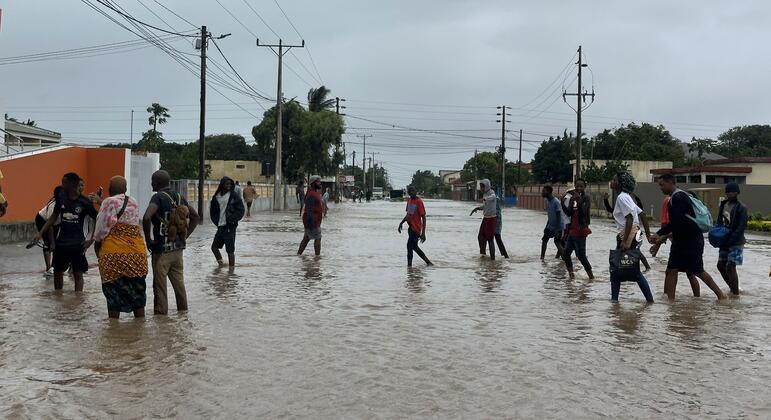
The head of aid coordination office, OCHA, in the country, Paola Emerson, told reporters in Geneva that more than half a million people have been impacted by the floods, triggered by heavy rains in the first weeks of the new year.
“The numbers keep rising as extensive flooding continues and dams keep releasing water to avoid bursting,” she said.
Mozambique’s Gaza province is most affected along with Maputo and Sofala provinces.
‘Melting’ houses
Speaking from Xai-Xai, Gaza’s capital city, Ms. Emerson stressed that 90 per cent of the country’s people live in adobe houses, which are earth-based structures “that basically melt after a few days’ rains”.
Health facilities, roads and critical infrastructure are also heavily impacted. Ms. Emerson said that some 5,000 kilometres of roads have been damaged across nine provinces, including the main road linking the capital Maputo to the rest of the country, which is currently inaccessible, resulting in major supply chain disruptions.
Meanwhile, dams continue to release water even as heavy rains subside.
“From just one dam, up to 10,000 cubic metres-worth of water were being discharged. That is approximately 25 times the amount of water that could be held in the press briefing room you are in today, every second,” Ms. Emerson told journalists, seated in a room with capacity for more than 100 people.
“You cannot imagine the strength of this water and the impact it has on people and the infrastructure.”
National emergency
The Government of Mozambique has declared a national emergency and has established an emergency operations centre in Gaza province. Xai-Xai, which is near the Limpopo River, has been inundated, prompting evacuations. Ms. Emerson said that authorities have issued alerts for downtown Xai-Xai, “including warnings of crocodile risks in flooded areas”.
“River levels are rising and are reaching urban areas or heavily populated areas,” she said. “The crocodiles that are in the Limpopo River…are able to get into urban or populated areas that are now submerged underwater.”
Also speaking from Xai-Xai, the UN Children’s Fund (UNICEF)’s Chief of Communication in Mozambique, Guy Taylor, warned that flooding is “turning unsafe water, disease outbreaks and malnutrition into a deadly threat for children”.
Lethal combination
The combination of waterborne diseases and malnutrition “can often prove lethal,” he said, stressing that even before the floods, four out of every 10 children in Mozambique experienced chronic malnutrition.
“This renewed disruption to food supplies, to health services and to care practices threatens to push the most vulnerable children into a dangerous spiral,” he insisted.
Mr. Taylor added that Mozambique is now entering into its annual cyclone season, creating the risk of a double crisis. “We can prevent disease, deaths and irreversible losses to children, but we need to act fast,” he said.
The UNICEF spokesperson described Mozambique as “a country of children and young people”, with an average age of 17.
“When floods and cyclones strike, as they have repeatedly and with increasing frequency over recent years, it’s the youngest and children who are hit hardest,” he concluded.