
Wednesday, January 21, 2026
By Kutlwano Phumudi
- Published Jan 2026
University and TVET college students funded by the National Student Financial Aid Scheme (NSFAS) receive a monthly living allowance of R1,716, intended to cover food, toiletries, and basic personal maintenance. In theory, this amount should support students’ essential needs. In practice, rising inflation and escalating living costs are steadily eroding its value, leaving many students financially exposed.
Students across institutions report that the allowance fails to cover even 80% of their basic monthly needs, forcing them into what many describe as a “sacrificial lifestyle”,cutting meals, delaying necessities, or prioritising survival over academic focus.
The purpose of NSFAS and the reality today
NSFAS was formally established in 1999 as an income-contingent loan scheme and later transitioned into a bursary model aimed at redressing historical education inequality. It targets students from poor and working-class households, specifically:
• Families earning below R350,000 per annum
• SASSA grant recipients
• Students with disabilities (household income capped at R600,000)
• Students who began studying before 2018 with household income below R122,000
As of 2025, NSFAS funds approximately 900,000 students, operating on a budget of R71 billion, according to Acting CEO Wassim Carrim.
While the intent of the scheme remains commendable, the financial adequacy of the allowance has come under increasing strain.
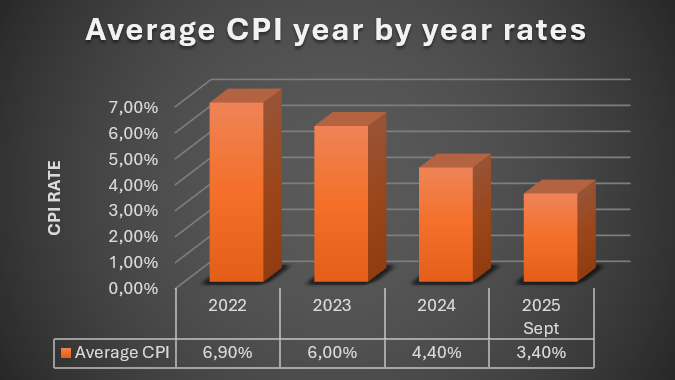
Although the NSFAS living allowance has increased nominally over time, it has not kept pace with inflation:
Source: STATSSA
• 2022: R1,500 (NSFAS allowance)
• 2023: R1,500 (NSFAS allowance)
• 2024: R1,650 (NSFAS allowance)
• 2025: R1,716 (NSFAS allowance)’
In real terms, this means students can afford less each year, even when the allowance increases. Inflation reduces purchasing power, and fixed allowances effectively become shrinking budgets.
As one example, a loaf of bread costing R20 represents 1.17% of the monthly allowance. If purchased weekly, bread alone consumes roughly be at 5.8% of the allowance before accounting for groceries, toiletries, transport, or personal care. For many students, funds run out within 8–10 days, leaving a “dry last week” that has become a recurring reality.
Expenditure data from four NSFAS-funded students across different institutions and provinces shows that three out of four operate on a monthly deficit.

The shortfall forces trade-offs that undermine both dignity and academic performance.
Buhle Luvono, a final-year BCom Financial Sciences student and Tutor, explains that even small increases in inflation or VAT mean the R1,716 allowance buys far less each year. A fixed allowance becomes a shrinking budget in real terms.
From a financial perspective, the allowance ignores emergencies and hidden costs. There is no buffer for health expenses, meaning students often cut back on food to cope.
Essential costs like sanitary products and period pain medication are also overlooked, despite being non-negotiable.
The book allowance similarly falls short in some programmes, textbooks alone exceed the amount provided, forcing students to use food money for academic materials.
The current system assumes a ‘perfect’ student with no additional needs, but for most students, the numbers simply do not add up.”
On-campus students receive an estimated average of R14,000 loaded into meal accounts for 10 months, alongside R370 per month for toiletries and maintenance. Spread across the academic calendar (February to late November), this amount remains insufficient to cover consistent meals and basic personal needs, resulting in another structural deficit.
Comparison with other bursaries
When compared to other public and private bursaries, NSFAS allowances are on average 52.29% lower, according to available bursary comparisons. Notably, the allowance sits below the R2,315 adult poverty line, raising serious questions about adequacy and sustainability.
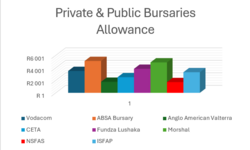
Source: Lifereset with Boni
NSFAS did not respond to requests for comment sent to its media and communications team by the time of publication. During a briefing on 6 January 2026, Acting CEO Wassim Carrim stated that the 2026 NSFAS budget remains under consideration, pending the National Budget Speech scheduled for 25 February 2026.
Underfunded students face food insecurity, reduced concentration and academic performance and increased dropout risk.
If education is meant to be a pathway out of poverty, the contradiction becomes clear: students cannot escape poverty while being funded at poverty-line levels.
As inflation continues to reshape household realities, the question is no longer whether NSFAS supports access to education but whether it supports survival with dignity.
Can students realistically be expected to succeed on an allowance that no longer meets basic living costs?


