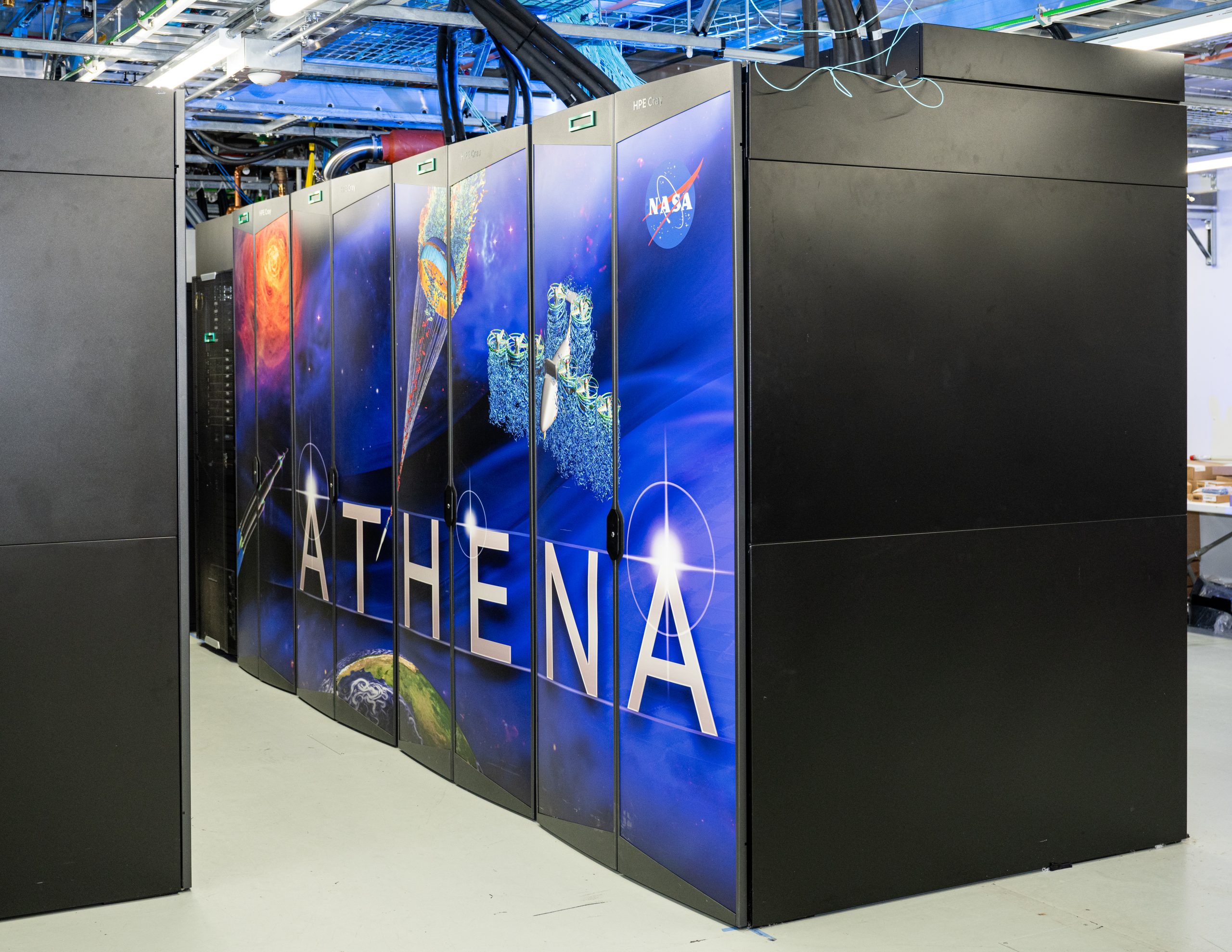
NASA is announcing the availability of its newest supercomputer, Athena, an advanced system designed to support a new generation of missions and research projects. The newest member of the agency’s High-End Computing Capability project expands the resources available to help scientists and engineers tackle some of the most complex challenges in space, aeronautics, and science.
Housed in the agency’s Modular Supercomputing Facility at NASA’s Ames Research Center in California’s Silicon Valley, Athena delivers more computing power than any other NASA system, surpassing the capabilities of its predecessors, Aitken and Pleiades, in power and efficiency. The new system, which was rolled out in January to existing users after a beta testing period, delivers over 20 petaflops of peak performance – a measurement of the number of calculations it can make per second – while reducing the agency’s supercomputing utility costs.
“Exploration has always driven NASA to the edge of what’s computationally possible,” said Kevin Murphy, chief science data officer and lead for the agency’s High-End Computing Capability portfolio at NASA Headquarters in Washington. “Now with Athena, NASA will expand its efforts to provide tailored computing resources that meet the evolving needs of its missions.”
Supercomputers like Athena are critical to missions and research across the agency, providing the computational power necessary to simulate rocket launches, design next-generation aircraft, and train large-scale artificial intelligence foundation models capable of analyzing massive datasets to uncover new scientific insights. The supercomputer is available to NASA researchers and external scientist and researchers supporting NASA programs who can apply for time to use the system.
The name Athena was selected through a contest held in March 2025 among the agency’s High-End Computing Capability workforce, which chose the name of the Greek goddess of wisdom and warfare because she is the half-sister of Artemis.
Managed by NASA’s Office of the Chief Science Data Officer, the High-End Computing Capability portfolio supports a flexible, hybrid computing approach that combines supercomputers with access to other tools, such as commercial cloud platforms. This strategy enables NASA teams to choose the most effective computing environment for their research, whether running complex simulations, developing and deploying AI models, or performing large-scale data analysis.
The project’s capabilities will continue to expand as the agency invests in advanced supercomputing to meet the growing complexity of its missions. As exploration pushes further into the universe, the ability to compute quickly, efficiently, and intelligently will be more important than ever. With Athena, NASA is laying the digital foundation for the next era of discovery.
To learn more about high-end computing at NASA, visit: