


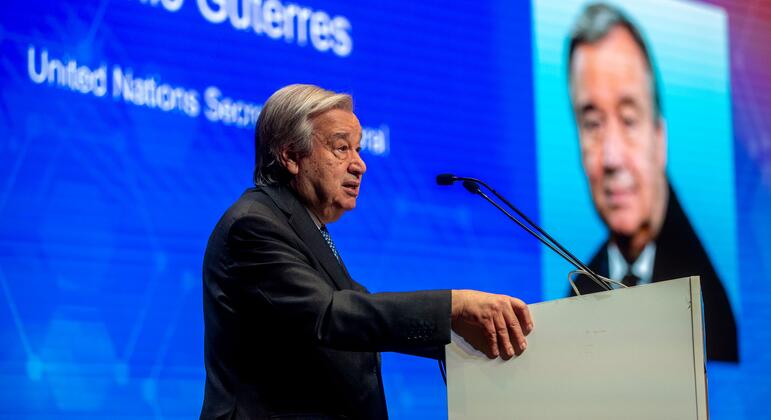
United Nations Secretary-General António Guterres has emphasized the critical role of science-led governance in harnessing Artificial Intelligence (AI) for sustainable development. “Guided by science, we can transform AI from a source of uncertainty into a reliable engine for the Sustainable Development Goals (SDGs),” he stated, urging the international community to create a future where policy effectively guides technological advancements.
New Expert Panel Established
Guterres highlighted the rapid pace of AI innovation, which often outstrips humanity’s capacity to fully comprehend and govern it. He stressed that effective AI policy must be grounded in verifiable facts, not guesswork, to ensure AI serves humanity. To address this, the UN is establishing mechanisms to center science in international AI cooperation, beginning with a newly formed body comprising 40 leading experts.
The Independent International Scientific Panel on Artificial Intelligence is tasked with bridging the “AI knowledge gap” and evaluating the real-world impacts of new AI technologies on economies and societies. This initiative aims to enable countries to act with clarity, irrespective of their AI capabilities.
Accelerating Progress and Anticipating Risks
The Panel will provide a foundational analysis, helping Member States transition from theoretical discussions to practical coordination and evidence-based decision-making. Guterres asserted that science-led AI governance is not a hindrance to progress but an “accelerator for solutions.” It will help identify areas where AI can yield the greatest and fastest benefits, making progress “safer, fairer, and more widely shared.” The international community will also be better equipped to anticipate AI’s potential impacts, such as risks to children or labor markets, allowing countries to prepare, protect, and invest in their populations.
Addressing Fragmentation Risks
Guterres acknowledged the challenges to international cooperation posed by strained trust and increasing technological rivalry. He warned that a lack of a common baseline could lead to fragmentation, with different regions adopting incompatible policies and standards, ultimately increasing costs, reducing safety, and exacerbating divides.
He suggested that countries can align their technical standards, guided by the Independent Panel and the upcoming Global Dialogue on AI Governance in Geneva. This alignment is crucial for a cohesive approach to AI regulation.
Ensuring Meaningful Human Oversight
Concluding his remarks, Guterres underscored that while science should inform AI governance, human control must be a tangible reality. This necessitates “meaningful human oversight in every high-stakes decision – in justice, healthcare, credit” and clear accountability, ensuring that “responsibility is never outsourced to an algorithm.” He emphasized the public’s right to understand how decisions are made, to challenge them, and to receive clear answers.