The exchange of data in the blink of an eye has become a given in much of the world – and yet we rarely pause to think about what makes it all possible: a complex global network of cables in the depths of the ocean that silently connects us.
In the modern information age, undersea cables have become a strong foundation for digital connectivity, Tomas Lamanauskas, Deputy Secretary-General of the International Telecommunication Union (ITU) has told UN News, ahead of a global summit on the issue beginning in Portugal on Monday.
Trillions of dollars in transactions in the global economy and the continuous accessibility of information takes place through it.
“About 99 per cent of the international internet traffic goes through submarine cables. Even the conversation you and I are having right now is carried through these cables,” he said.
“People know the visible access points, such as mobile networks, satellites, and fixed internet, but the underlying infrastructure that supports them is the vast network of submarine cables — our digital highways.”
These invisible highways, consisting of fiber-optic wires connecting landing points, are placed hundreds of metres below the surface of the ocean by cable-laying ships.
Mr. Lamanauskas underscored that as our reliance on digital connectivity continues to grow, strengthening the resilience of these cables and developing collective strategies have become increasingly important.
This will be a key focus of the Second International Submarine Cable Resilience Summit, taking place on Monday and Tuesday in Porto, Portugal.
Rapid data transmission
Connecting different parts of the world through communication cables is not a new idea. In 1850, England and France were linked for the first time by an undersea telegraph cable.
Since then, technology has steadily evolved, from telegraph services to telephone networks, and now to high-speed internet carried by fiber-optic cables. Today, hundreds of terabits of data pass per second through these cables laid along the seabed.
Across the globe, there are over 500 commercial submarine cables, linking continents, markets, and households.
Relatively thin and roughly the width of a garden hose, these cables stretch for around 1.7 million kilometres – long enough to wrap around the Earth several times.
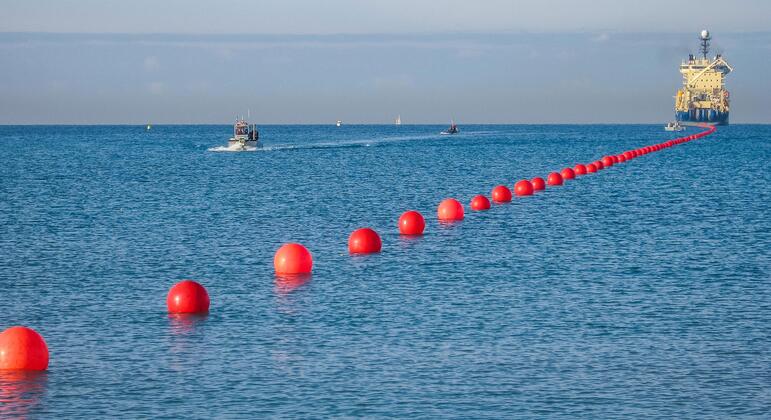
To lay them, the seabed is surveyed to find routes with fewer risks and less impact on the environment. Then, special ships unroll large reels of fibre-optic cable onto the ocean floor.
Close-up of submarine cable being wound onto industrial reels. The Second International Submarine Cable Resilience Summit will take place on 2–3 February 2026 in Porto, Portugal.
Cable traffic disrupted
With these cables increasingly forming the backbone of the global economy, any disruption in data flow can become instantly noticeable, impacting economic activities, emergency and tech services, security systems, and internet access for billions worldwide.
There are typically 150 to 200 cable incidents each year, averaging about three to four per week.
The ITU senior official recalled that “in recent years, there have been quite a few high-profile incidents, from the Red Sea to West and East Africa.
“For example, in 2024, submarine cable incidents in the Red Sea disrupted an estimated 25 per cent of data traffic between Europe and Asia.”
Outages in cable connectivity may result from earthquakes, underwater landslides, and volcanic eruptions. However, statistics show that around 80 per cent of incidents are caused by human activity, from ship anchors or fishing trawlers damaging cables.
Every millisecond matters
Mr. Lamanauskas cited the example of Tonga, which has experienced three major disruptions since 2019, caused by an earthquake, volcanic eruptions and improper anchoring. Because of the lack of a diverse network in remote regions, when a cable is cut, a vast territory can go offline.
“Imagine yourself and your entire community being offline for a week, unable to access essential services like digital healthcare, access to information, and education.”
“Imagine the impact on stock traders in New York if even a millisecond delay occurs due to cable congestion or a submarine cable incident. Every moment matters.”
Repairing the invisible highways
Aside from abrasion and natural wear and tear, “a portion of the cable infrastructure laid around the dot-com boom of 2000 is now reaching maturity, as these cables were designed for an average 25-year lifespan,” he added.
DSG Lamanauskas explained that in the event of an incident, engineers are usually quickly able to identify the affected area and “the actual repair work itself is not always the most complicated piece. What’s often more complex is securing all the required permits and licenses, especially when multiple or overlapping jurisdictions are involved.”
Depending on the location and scale of damage, the summoning of cable ships and the repair work can range from days, weeks to months. In busy locations, these ships are usually close by but reaching remote areas can take longer. In many countries, the lack of a clear focal point to manage these operational requirements adds to the challenge.
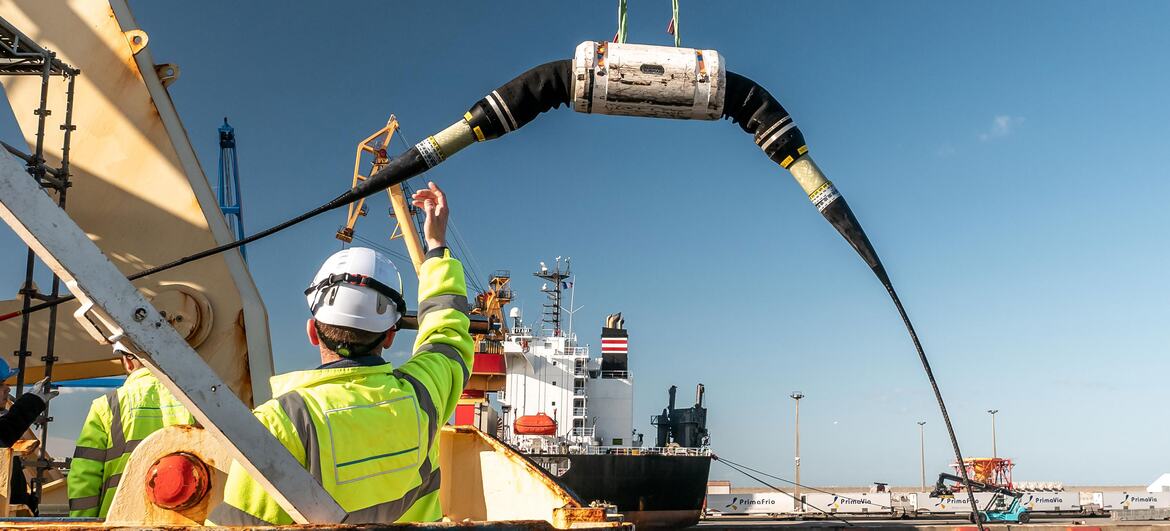
Worker directing deployment of submarine cable at port. The Second International Submarine Cable Resilience Summit will take place on 2–3 February 2026 in Porto, Portugal.
Mr. Lamanauskas noted that laying new cables is often a multi-year project that takes a significant amount of time. “There’s extensive planning involved, and it’s usually costly too. While shorter cables cost millions, the longer ones can run into the hundreds of millions.”
What is ITU doing?
As the UN agency for digital technologies, ITU works to enhance the resilience of global submarine cables through collaboration, standard setting, and technical guidance. Its priorities include developing resilient measures, streamlining maintenance and repair processes, and adopting more sustainable practices.
“Over the last 40 years, the capacity of these optical cables has been increasing by 40 per cent yearly. It’s an exponential growth which in turn powers the exponential growth of the internet,” Mr. Lamanauskas added.
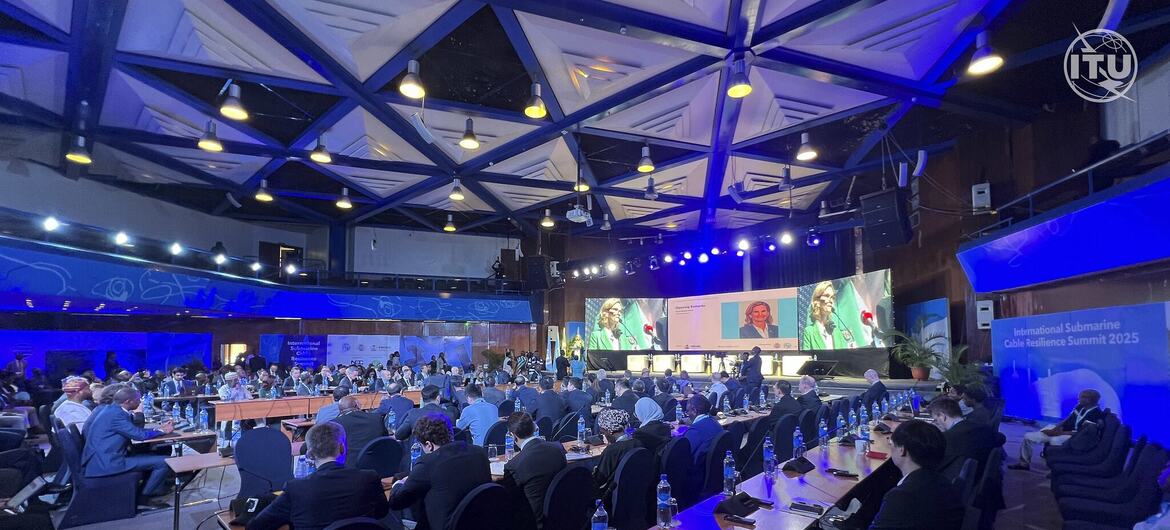
International Submarine Cable Resilience Summit 2025, ITU Conference
Mr. Lamanauskas clarified that ITU isn’t an operational body and doesn’t repair cables.
“Instead, we focus on creating the right enabling environment by shortening permitting timelines, establishing clear points of contact, raising awareness to prevent accidental damage, and facilitating faster repairs.”
As demand for connectivity and data surge with unprecedented speed, these efforts will play a key role in bolstering the foundation for shared progress and shaping the future of the global digital landscape.