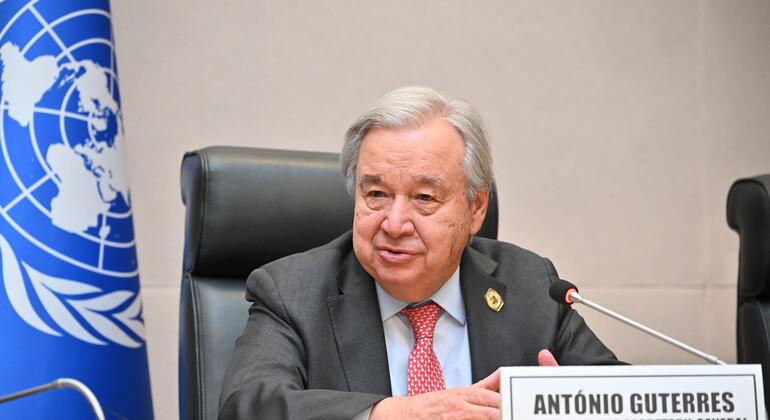
In a world marked by division and mistrust, he said, the African Union (AU) stands as a “flagship for multilateralism,” as he addressed the 39th African Union Summit in Addis Ababa.
Mr. Guterres praised Africa’s global leadership in “the struggle for justice and equality,” noting that the UN-AU partnership is stronger than ever, built on “respect, constant dialogue and unwavering solidarity.”
Cooperation has reached “new heights” over the past decade, he added, pointing to joint frameworks on peace and security, sustainable development and human rights.
Peace in Africa
The Secretary-General outlined three priorities for deeper cooperation: peace, economic action and climate justice.
On peace, he called for an immediate cessation of hostilities in Sudan, renewed dialogue in South Sudan, and respect for the territorial integrity of the Democratic Republic of the Congo. Across the Sahel, Libya and the Horn of Africa, he stressed the need for African-led political solutions backed by sustained international support.
Economic action
Mr. Guterres further warned that developing countries face a $4 trillion annual Sustainable Development Goals (SDGs) financing gap, while Africa loses more to debt servicing and illicit financial flows than it receives in aid.
At a press conference following the summit, he said it is “simply unconscionable” that Africa must contend with “an economic and financial system that remains totally unjust.”
He called for tripling the lending capacity of multilateral development banks and ensuring developing countries have “a real voice and a meaningful participation” in international financial institutions.
No more plundering
He also stressed that African countries must benefit directly from their natural wealth: “No more exploitation. No more plundering. The people of Africa must benefit from the resources of Africa.”
He urged that African countries benefit “first and fully from their critical minerals through fair, sustainable value chains and manufacturing,” in line with UN recommendations.
Climate justice
On climate, Mr. Guterres warned that “the science is unequivocal – the planet will overshoot the 1.5 degree Celsius limit.” The 1.5°C threshold, enshrined in the Paris Agreement, is considered critical to avoiding the most catastrophic and irreversible climate impacts.
“Africa did not cause the climate crisis,” he said, yet it faces faster-than-average warming, droughts, floods and deadly heat – “climate injustice – plain and simple.”
He called on developed countries to triple adaptation finance, mobilize $1.3 trillion annually for developing countries by 2035, and scale up the Loss and Damage Fund.
Reforms now
Mr. Guterres also underscored the urgent need for reforming global institutions.
The absence of permanent African seats on the Council is “indefensible; this is 2026 – not 1946,” he said, adding: “Whenever decisions about Africa and the world are on the table, Africa must be at the table.”