
Tuesday, March 24, 2026
On Tuesday, March 24, Downtown Music Gallery continued its ongoing weekly in-store concert series with a night featuring eight experimental vocalists. The venue was so highly attended that the entire store was full, and people were watching from outside the entrance to the store.
Before the performances, Bruce Gallanter, the owner of Downtown Music Gallery, started the event with a verbal history of vocalists:
((Bruce Gallanter ))
))
Alright, I want to welcome everybody.
 This is Downtown Music Gallery.
 We have music here every Tuesday starting at 6.30.
 This has been going on for more than 25 years.
 Usually three bands.
 Over the last couple of years I've decided to do some more kind of thematic evenings.
 So tonight we have eight vocalists that are going to be singing for us.
 It's going to be a different night than what we usually have and I'm really glad about that.
 I prepared a little introduction that has to do with the history of
 jazz vocals and vocals in general.
 And it starts, you have to picture this, we're going to go back in time 315,000 years.
 That's considered to be the dawn of mankind.
 We're in North Africa, there is a tribe
 or whoever was there at the time.
 They're descendants of Adam and Eve.
 They're walking across the desert very slowly.
 This is before language, so the only sounds that they're able to create are vocal sounds without words.
 So this is how it starts.
 And they make their way, and they end up
 later became Israel and they grew over time until they became 12 tribes and then each one of those tribes left and one stayed in Israel and the rest of them traveled to different places on this planet.
 The last tribe ended up in the US in the Midwest.
 They're called the Lost Tribe of Israel and they became the first Native Americans
 And it took about 50,000 years for those tribes to evolve into having people all around our planet.
 And many languages came out of that.
 Every country, like 100 countries, each one had their own language.
 And every country, those languages would be hundreds of dialects.
 So you have all different types
 to the beginning of songs, vocal songs first, and then eventually percussion instruments, flutes, stringed instruments, and we're gonna move forward to the beginning of the 20th century.
 Between 1900 and 1920, this is like in the US, you have vaudeville bands,
 the very beginning of what became Dixieland and jazz.
 You also had kind of folk stuff going on.
 And as far as classical composers go, Igor Stravinsky and Béla Bartók and Edgar Varese composed pieces in the late
 teens and 20s, and that's kind of a beginning of, you know, all the pre-20th century classical stuff is more kind of melodic and easier to deal with, but when Stravinsky composed Rites of Spring, it was very violent.
 It had dancers dressed as animals, and people went wild when this music occurred.
 They flipped out, they couldn't deal with it, it was too much for them.
 So in their 20s,
 This is what happened.
 Duke Ellington's band moved from DC to New York.
 Count Basie's band moved from Kansas City to New York.
 And you had the beginning of an era called the big band era.
 And that existed from late 20s to around 1945.
 You had hundreds of big bands that would travel around the country and play.
 This was a form of entertainment for people.
 People would get together and they would dance.
 to see these big bands.
 My parents used to go out dancing on weekends in the 40s and check out these big bands.
 And there were a lot of them.
 And I've been listening to more and more just to get an idea of how things unfolded.
 And a lot of those big bands had singers in them.
 You probably know a few of the singers like Bing Crosby, Frank Sinatra, Ella Fitzgerald, Billie Holiday, people like that.
 And that era existed for about 20 years.
 And then when World War II happened and the world kind of changed in a lot of ways, all the big bands started to break up and stop playing.
 And when people got back from World War II, you had a new form of music that had occurred.
 And these were members of Billy Eckstine's big band, Charlie Parker, Dizzy Gillespie, Max Roach, all these people.
 And they started something which was called Bebop.
 And the bebop was a small group thing.
 It was hard to play.
 It's very complex.
 And it was the first time that music, jazz music, was not about dancing and entertainment.
 It was about sitting and listening, snapping your fingers, creating poetry.
 And it affected other things, too.
 So dance, abstract art, all these things sort of came out of that.
 You had this hipster language that came out of the bebop thing.
 We'll hear Buddy Lauren doing some hipster language during his set, maybe.
 Who knows?
 And in 40, so we had the bebop thing.
 Now, that lasted approximately 10 years.
 And in 1949, you have a session called Earth of Cool.
 That's Miles Davis, Jerry Mulligan, Lee Konitz, Lenny Tristano.
 And that was another break from what the bebop thing was about.
 It was a cooler form.
 of jazz.
 And the weird thing was, those beboppers that we talked about who created the cool things, that was an East Coast thing, but the cool thing became more popular on the West Coast.
 So you had a whole West Coast school in the 50s of all those people doing the cool school stuff.
 Now also in the 50s, Dizzy Gillespie put together a big band.
 And in his big band, four members of his big band were
 John Lewis, Bill Jackson, Connie Kay, and Percy Heath.
 They started a quartet called the Modern Jazz Quartet.
 Now the thing about them is they wore tuxedos.
 They didn't want to play in bars.
 They wanted to be taken more seriously.
 So that is the beginning of another form of sort of jazz.
 And Dizzy Gillespie Big Band did a song called A Bird in Igor's Yard.
 That was written by George Russell.
 And it was supposed to be a blend of Charlie Parker and Igor Stravinsky.
 So a term was coined for that music.
 It was called third stream.
 It was coined by Gunther Schuller.
 So in the 50s, you had the end of bebop.
 You had the next phase of that, which is called hard bop.
 which is like bebop but with a little bit of funk in there.
 And you had people who invented that were Art Blakey and Horace Silver.
 So the 50s, let's talk about the 50s.
 The 50s, a lot of different changes in music were going on.
 You had some blues cats coming up from down south and making their way to Chicago and playing blues.
 You had R&B guys doing their thing.
 You had pop singers.
 You had also country and rockabilly.
 Elvis Presley comes from all those elements, including gospel.
 That's all part of his thing.
 And in 1959, this was a very important year.
 Three records came out that changed the future of jazz.
 One was Kind of Blue by Miles Davis Sextet, I guess, which is great.
 And it had this thing called modal jazz, which opened up the form to be a little bit freer.
 You had another record by the Dave Brubeck Quartet called Time Out.
 And that record included songs in weird time signatures.
 You had Blue Mondewala Turk and Take Five.
 So that is another kind of more progressive element that was very popular at the time.
 And another record that came out that year that wasn't noticed at the time was Sun Ra's record Jazz and Silhouette, which is a big band record, but it's very progressive.
 And then in California, you had Ornette Coleman Quartet, who moved to New York in 1960.
 They played for a month at the Five Spot.
 And when they played, it was very controversial.
 because no piano player, their music is very kind of free and open, and half the people who went to the gigs hated it, and the other half of the people loved it.
 And there was fighting going on about if it was important music or not, or if it was really jazz.
 All those arguments are going on.
 The same period of time, John Coltrane was playing
 in Miles Davis' quartet, and his solos were getting longer and longer.
 And he met up with John Gilmore, who was the sax player in Sun Ra's band, who was playing with multiphonics.
 And this is an early way of getting weird sounds on the sax that are now part of the vocabulary of the saxophone.
 So Coltrane is playing these long solos, and Miles said, you know, we're going on tour in Europe, 1960, and Trane says,
 I don't want to tour.
 I want to start my own band and I want to do my own thing."
 And Miles begs him, please go on tour.
 So he goes on tour for 60.
 After he does that tour, he starts his own quartet.
 And his own quartet's Elvin Jones, Jimmy Garrison, and McCoy Tyner.
 And so between 60 and 64 you have a freer form of jazz that's now coming out.
 Now also during that period of time you have the beginning of what we call protest singers.
 So you had like Woody Guthrie and then Pete Seeger and then you had Bob Dylan and these are people that wrote lyrics that talked about social justice and civil rights.
 This is a very important thing because it was a way of expressing how you felt
 and if you felt the world was unjust and you wanted to deal with it.
 I remember when I was at day camp, I was about eight years old, and I had to learn the words to Blown in the Wind by Bob Dylan, which is made popular by Peter, Paul, and Mary.
 And I learned the words, and I remember thinking to myself, this is fascinating.
 These words actually make me think about the unfairness of the world and what we can do about it.
 And I realized how much lyrics and voices really affected the way I saw the world.
 Before I started reading newspapers, music was the one thing that spoke to me.
 And the more music I listened to, the more different types of music I listened to, all those things were part of my understanding of the world.
 I discovered a band called The Mothers of Invention when I was 13.
 That's Frank Zappa's band, and Frank Zappa
 had this view about the unfairness of society.
 He wrote a song called Trouble Every Day.
 It's a long protest song.
 I have it memorized, but I'm not going to do it now because this is more about other people tonight.
 No, no, no.
 I'll do it.
 I've done it here once, and I'll do it again.
 But it's very long.
 But I think it's an important thing.
 Now, the vocal thing.
 This is all changing over time we have jazz vocalists singing with big bands singing on the road and then in the sixties people start experimenting with their voices uh... so you have people like gene lee uh... who else?
 harry woodard jay clayton yes
 I mean, a lot of these people I got to know in the 70s.
 I remember seeing, late 70s, Ellen Christie.
 She was at a jam session I was at in New Jersey, and she was great.
 And I didn't know who she was.
 And Lisa Sokoloff, I remember seeing.
 I saw Jean Lee play a bunch of times, because I was friendly with her, and Gunther Hoppel.
 But I've always been attracted to vocalists, strong vocalists, and also vocalists who take chances and learn how to do different things with their voices.
 So we're going to celebrate vocalists tonight.
 We have eight of them that are going to be playing in four sets.
 All of them are different.
 They're all coming from different places.
 They're all going to speak to us in different ways.
 I'm glad to see more people here than what we usually have.
 I think that's a beautiful thing.
 I'll do more thematic things in the future.
 And I want to thank all you people out there for showing up.
 And the first set is going to start.
 And Skylar here, he was here on Saturday night with a band.
 And man, he blew me away.
 He is really something else.
 That's all I'm going to say.
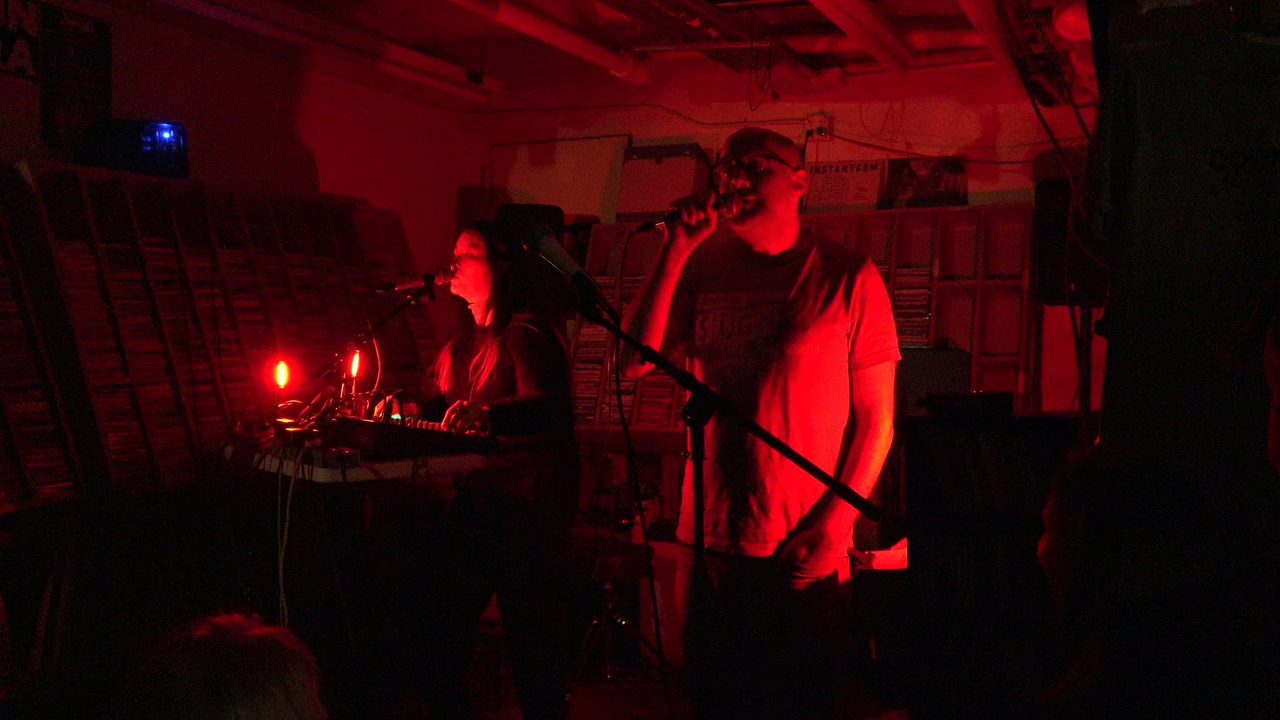
First was Lorin Benedict and Charmaine Lee, who performed in an almost entirely dark room, lit only by red light. Benedict performed vocals with a microphone only, while Lee performed using a electronic set-up on the table in front of her. ((length of perf))
Second was Kyoko Kitamura, who instead of performing in the back of the venue like most performers, performed in the middle, surrounded by people, using her voice and a few hand-held objects. She started off explaining “as musicians, we’re constantly working with layers of listening, and as we bring awareness, it’s almost like we’re amplifying it, and I’m gonna be adding this very subtle layer on top of everything that’s going on;” she ended the performance by having the audience join her in making progressively louder exhaling shouts.
Third was Amy Sheffer and Rosi Hertlein, who performed several pieces, with Hertlein also playing violin. For the last piece, they brought our props, which Hertlein juggled in front of the nearby audience, who sometimes assisted. ((details))
Last was Noa Fort, Yoon Sun Choi, and Elena Camerin, who all performed using microphones connected to the PA. All three performers used some degree of sound effects alternating with verbiage.
After each performance, there was considerable applause.


