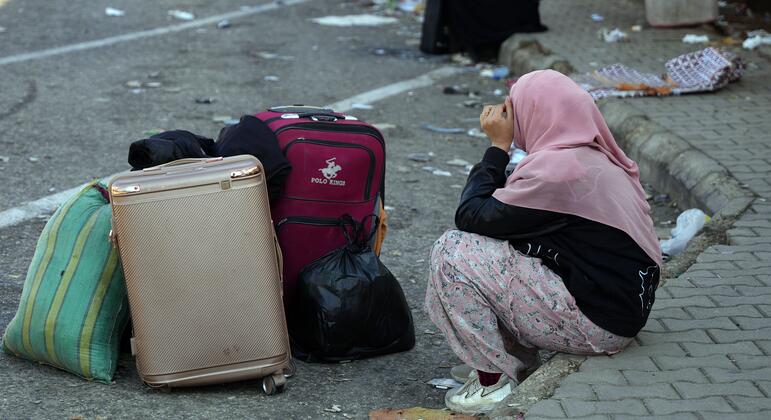
“Repression of civic space and freedom of expression has significantly deepened across the Middle East, compounding the already existing climate of fear unleashed by multiple conflicts and crises,” UN human rights chief Volker Türk said on Wednesday.
Iran accounts for the bulk of reported arrests, impacting nearly 2,350 people since the conflict began, according to Mr. Türk’s Office, OHCHR. Those apprehended face national security charges, “including terrorism, dissent, alleged espionage and ‘cooperation with the enemy’”.
New tanker attack
In other developments, maritime monitors reported that a missile struck a tanker early Wednesday in Qatari territorial waters. None of the crew members on board was injured and there was no environmental impact because of the incident, according to the Qatari authorities.
Fuel tanks at Kuwait International Airport were also attacked, amid ongoing strikes on Gulf States attributed to Iran, with civilian infrastructure also set ablaze in Bahrain, according to reports.
The Iranian capital, Tehran, meanwhile, faced further reported strikes on Wednesday.
Expedited trials
Many of those arrested during the January protests across Iran and during the ongoing war face “shocking conditions”, expedited proceedings and the risk of execution, the High Commissioner noted.
Eight people have reportedly been put to death, including three linked to the mass protests, amid an internet blackout entering its fifth week and “pervasive interrogation and intimidation of civilians by heavily armed security forces in public spaces”.
“Dozens of others who have been convicted – including children – face a similar fate,” Mr. Türk warned, before calling for all executions to be halted immediately.
Death in custody
In Bahrain, OHCHR highlighted the death in custody of activist Mohammed Al-Mousawi on or around 27 March, along with “serious allegations of his torture”.
The UN rights chief pointed to other arrests in the Gulf State, “including those of foreign nationals, for filming or sharing content on social media platforms, or alleged expression of sympathy for the enemy. In cases of individuals accused of espionage, Bahraini public prosecutors have sought the death penalty.”
In Qatar and the United Arab Emirates, OHCHR said that 313 and 109 people have been detained respectively, “in relation to the filming or sharing of information, among other charges”.
Sensitive subject
In the UAE, 35 people have been sent for “expedited trial”, among them individuals who circulated video footage showing the impact of Iranian strikes and interceptions.
Foreign nationals are among those detained too, OHCHR said, citing reports.
In Kuwait, meanwhile, the UN human rights office highlighted a new decree imposing imprisonment and steep fines for the circulation of reports that seek to “undermine the prestige of the military” or erode public trust in it.
In Jordan, at least four critics were reportedly arrested since the Middle East war began on 28 February, including three members of the Jordanian Communist Party, two of whom remain detained on unknown basis, OHCHR said.
“We remind all States of their obligation under international human rights law to respect and protect people’s right to freedom of expression. Everyone has the right to express critical opinions, particularly on matters of major public concern, without fear of arbitrary arrest and punishment,” the UN human rights chief said.
Occupied West Bank restrictions
In the Occupied Palestinian Territory, Mr. Türk noted that the Israeli authorities had announced the detention of 200 Palestinians from 28 February to 6 March, including for posting on social media, and on suspicion of “incitement” and “glorification of the enemy”.
Israeli security forces have also increased raids of Palestinian communities across the occupied West Bank and “further tightened” movement restrictions, he said.
The High Commissioner also described how a 44-year-old Palestinian school principal in Dura, Hebron, was physically assaulted on 11 March in front of his family and his house was vandalised by Israeli authorities, for a post he had reportedly published on social media in support of Iran.
Food is distributed to families sheltering in a school in Beirut, Lebanon.
Fear and flight
Escalating violence in the Middle East has forced more than 202,400 people to flee Lebanon for Syria. Among them are 3,100 pregnant women, with 350 expected to give birth within the next month.
They are entering a country still shattered by 15 years of war. Having fled with no belongings, families are now eking out an existence in overcrowded, overstretched temporary shelters, according to the UN reproductive health agency, UNFPA.
These harsh environments lack adequate food, medicine and sanitation, leaving women and girls facing severe risks of sexual abuse and exploitation.
UNFPA is distributing hygiene kits and deploying mobile teams, but severe funding cuts have shuttered a third of its Syrian facilities.
“We cannot look away,” warned Enshrah Ahmed, UNFPA Representative in Syria.