

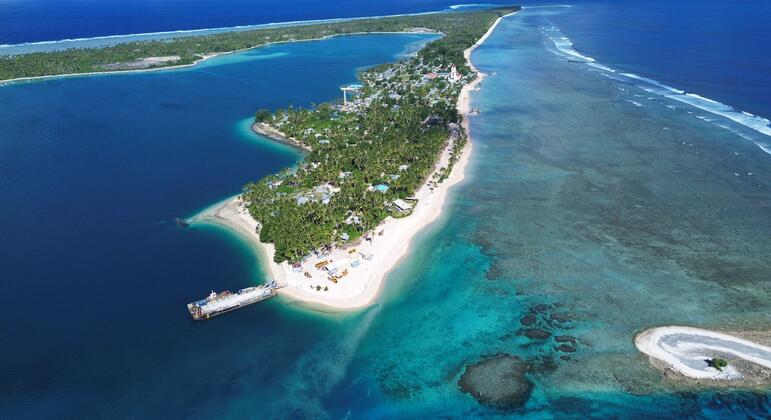
In 2025, over 90 percent of Tuvaluans sought Australian residency or citizenship through a visa scheme. Preemptively, in 2022, the Tuvaluan government established the first ‘digital nation’ in the metaverse to ensure the preservation of its statehood and culture should its physical territory vanish.
These small, isolated island communities, many with only a few thousand inhabitants, possess limited resources to confront the existential threat posed by rising sea levels. They are largely left to face this challenge alone.
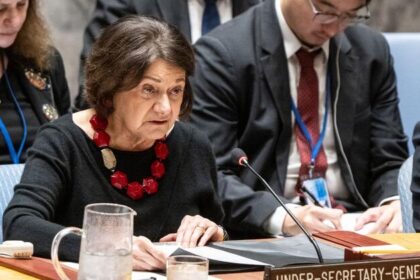
“A lot of times people say, ‘you’re just talking about a thousand people, you’re talking about six thousand people’. But for us, those 6,000 people are at the frontline of this climate crisis, and we owe everything to them to safeguard their livelihoods and not disturb their daily lives,” stated Tuya Altangerel, a senior official at the UN Development Programme (UNDP) in the Pacific, in an interview with UN News.
With support from the UNDP, the Tuvaluan government is intensifying efforts to protect the nation’s most populated islands.
Small Increases, Devastating Consequences
Sea level rise is primarily driven by global warming, which causes water to expand as it heats and accelerates the melting of land-based ice sheets and glaciers. Few regions are experiencing this phenomenon as rapidly as the Pacific Ocean. Here, factors like ocean currents and winds combine with global warming to create a ‘pile-up’ effect on some of the most vulnerable low-lying islands.
In the independent island nation of Tuvalu, sea levels have risen by 21 centimeters over 30 years, nearly double the global average. Projections suggest that at the current rate, 95 percent of the country could be submerged by 2100.
Why High Tides Are the Real Danger
The most significant day-to-day challenge for island communities is the increasing frequency and intensity of high tides. “Our islands are drowning,” Ms. Altangerel remarked.
Given that the country’s average elevation is less than two meters above sea level, traditional coastal protection methods, such as building sea walls or employing nature-based solutions like planting mangroves, are no longer effective in managing these tides. “If we plant mangroves, the mangroves will be simply swallowed by the sea… The king tide will just wash over the mangroves, or they can wash over the seawalls,” she explained.
It’s not just about coastal areas disappearing, it’s also the people’s sense of nationhood and also the future existence of these countries are very much under threat — Tuya Altangerel
Migration, a Potential Solution?
While adaptation projects are underway, migration remains a consideration. In 2023, the Tuvaluan and Australian governments launched the Falepili Union, a treaty enabling 280 Tuvaluans to relocate to Australia annually for residency or citizenship. Last year, 90 percent of Tuvalu’s population applied for the initial round of the visa ballot.
Similar agreements exist for citizens of Kiribati and Vanuatu to obtain visas for Australia. New Zealand offers 75 residency visas annually to citizens of Kiribati and Vanuatu, and the United States has an agreement with the Marshall Islands allowing citizens to live, work, and study in the US visa-free.
However, concerns exist regarding the potential impact on the culture and heritage of Pacific peoples, particularly those reliant on traditional livelihoods, if large-scale population movements occur.
Can a Nation Survive Without Land?
With rising sea levels, some island nations face the possibility of physical disappearance. “It’s not just about coastal areas disappearing, it’s also the people’s sense of nationhood and also the future existence of these countries are very much under threat,” Ms. Altangerel emphasized.
An International Court of Justice ruling in 2025 clarified that the loss of physical territory due to sea-level rise does not automatically lead to the loss of statehood or sovereignty. This allows Tuvalu to maintain its status as a nation-state, retaining rights over its ocean resources and its UN seat, even if its islands become submerged.
A Template in Tuvalu
In Tuvalu, the UNDP, in collaboration with the government and the Green Climate Fund, initiated a novel adaptation plan in 2017. This plan, based on detailed sensor mapping, aims to create over seven hectares of new land designed to remain above projected sea levels beyond 2100. The Tuvalu Coastal Adaptation Project involves dredging sand to build elevated land protected against storm surges on the islands of Funafuti, Nanumea, and Nanumaga.
“These are very drastic measures,” warned Ms. Altangerel, noting the project’s cost of nearly $55 million to date. “We basically rebuild the land around the atolls so that there is safe land where people can build shelters, housing.”
Phase two, launched in 2024, will add another eight hectares along the southern shoreline of Funafuti, the nation’s capital, on Fongafale island, where 60 percent of the population resides. Many Tuvaluans from less protected atolls have already relocated there seeking safety.
Additionally, the government and UNDP are supporting Tuvaluans through an insurance scheme for flooding caused by high tides. Initially, 400 households in Funafuti will receive automatic payments of up to $1,500 per high tide event.
For Tuvalu, Kiribati, and the Marshall Islands – three of the world’s four lowest-lying countries – the measures being implemented in Tuvalu could serve as a model for their future adaptation and survival. “If we manage to safeguard Tuvalu as a nation…we’re contributing all of this amazing work to be scaled up and replicated across the Pacific, but also across other small island developing States,” Ms. Altangerel stated.
Saving the Pacific
Seven years ago, while visiting the Pacific islands, which span thousands of miles across the world’s largest ocean, UN Secretary-General Antonio Guterres remarked, “if we save the Pacific, we save the world.”
As the world observes Earth Day on April 22, the efforts in Tuvalu are not merely about adaptation but are fundamentally about survival, raising the critical question of whether a nation can retain its land, identity, and future in the face of rising seas.
The Governments of Australia and New Zealand are supporting the protection projects in Tuvalu.