

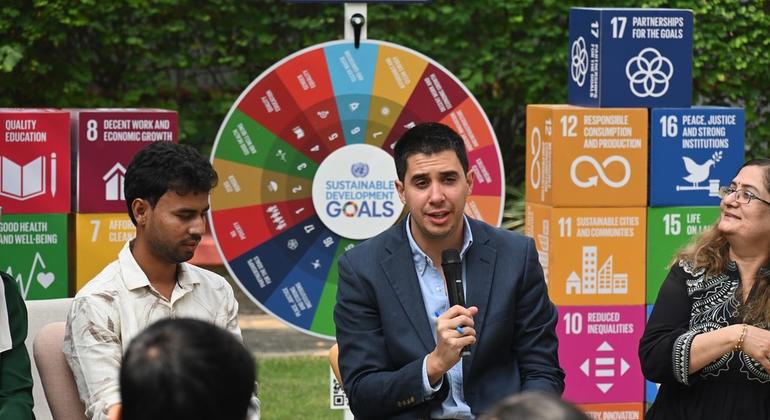
Felipe Paullier, the United Nations’ youngest-ever senior official, has been tasked with amplifying the voices of young people worldwide. Reflecting on his journey, Paullier shared his initial connection with the UN’s values during his high school history studies, never anticipating a direct role within the organization.
His extensive engagement with the UN system in Uruguay, collaborating with agencies like UNFPA, UNICEF, and UNDP on initiatives such as a national project focused on adolescent mental health and well-being, provided him with a deep understanding of the UN’s operational mechanisms.
While pursuing a master’s degree in administration at the University of Montevideo, Paullier successfully ran for the leadership of the first UN Office for Youth. His objective was to foster a robust connection with young individuals, ensuring their active involvement and participation. Eight months later, he received a call from UN Deputy Secretary-General Amina Mohammed, informing him of his selection for the role, with a commencement date set for 15 days later.
The initial year was dedicated to comprehending the existing challenges, assembling the team, identifying avenues to enhance the contributions of youth organizations and member states, and establishing the office as a platform for issue awareness. Paullier emphasized that the Office for Youth Affairs aims to foster collaboration, disseminate information, and raise awareness regarding the interests and concerns of young people globally.
The UN Office on Youth’s Three Core Agendas
Addressing the youth agenda involves understanding and supporting a significant global movement through three primary dimensions.
The first is the participation agenda, highlighting the critical need to include new generations in decision-making processes. The office actively connects with civil society initiatives aimed at linking youth with the UN, thereby creating environments where young people feel represented, empowered, and that their concerns are acknowledged and acted upon.
The second is the peace and security agenda. Amidst the highest number of active conflicts since World War II, young people are increasingly taking the lead in advocating for peace and urging governments to cease hostilities.
The third, and a prominent priority, is mental health and well-being. Millions of young people globally grapple with a silent crisis impacting all facets of their lives, including hopelessness, the adverse effects of hate speech in digital culture, limited opportunities in education, employment, and housing, the climate crisis, and the scarcity of supportive environments. These factors contribute to anxiety, depression, and, in severe instances, a loss of purpose and suicidal ideation.
To address this, the UN is spearheading a Global Youth Mental Health and Well-being Initiative. In just a few months, this initiative has united over 600 youth-led organizations across more than 80 countries, reaching over 13 million individuals, with 81 percent being young people. The initiative integrates youth empowerment with connections to international mental health networks and organizations like the WHO, UNICEF, and UNESCO, while also advocating for governments to prioritize youth mental health and implement responsive policies.
Mental Health in the Social Media Era
A key focus is on how individuals navigate technology in our rapidly evolving world. The challenge lies in managing our interconnectedness alongside increasing isolation, a paradox of the current era. Social media platforms often create echo chambers, reinforcing existing beliefs. The algorithms employed by these networks can foster polarization and leverage anonymity to spread aggressive messages, underscoring the necessity for more spaces that encourage genuine dialogue. In these digital realms, dialogue is often replaced by entrenched positions, leading to confrontation rather than mutual understanding.
The fundamental principles of the UN Charter—dialogue, the celebration of diversity, and international cooperation—offer guidance for addressing these challenges. Paullier affirmed that young people are already contributing to these efforts, and that small, individual changes collectively drive global progress.