

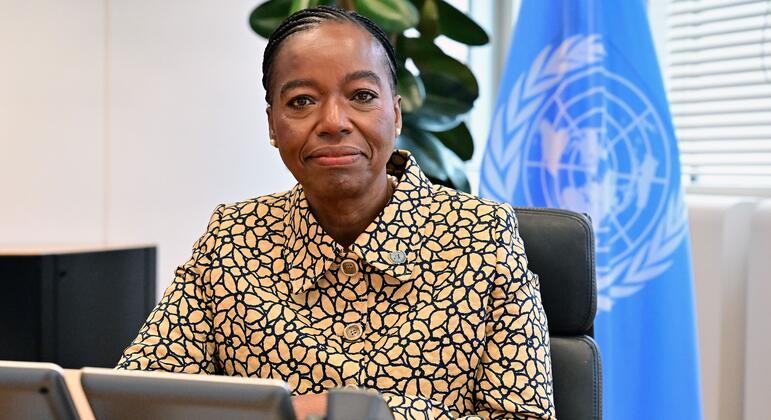
Monica Juma, the newly appointed Executive Director of the United Nations Office on Drugs and Crime (UNODC), has emphasized the critical importance of global cooperation in an era where criminal networks are increasingly complex, sophisticated, and interconnected. Juma, who also assumes the role of Director-General of the United Nations Office at Vienna, highlighted the vital connection between her mandates and the pursuit of international peace and security.
With extensive experience in defense, security, foreign relations, and multilateral cooperation, Juma issued a call for stronger collaboration to combat organized crime, corruption, terrorism, human trafficking, and technology-enabled threats ahead of the upcoming UN Crime Congress in Abu Dhabi.
Following decades of public service in Kenya, Monica Juma now holds two significant leadership positions within the United Nations. As Director-General of the UN Office at Vienna, she represents the Secretary-General at a key hub outside New York. In her capacity as UNODC Executive Director, she leads global efforts to prevent crime and strengthen justice systems.
Juma described her appointment as an honor, taking up the role at a “critical time for multilateralism.” She expressed her eagerness to contribute to the UN’s mission of building “a safer, more just world.” She commenced her duties last month and was formally sworn in by Secretary-General António Guterres last Thursday.
Expertise in Security, Diplomacy, and Governance
Before joining the UN, Monica Juma served as Kenya’s first National Security Advisor and Secretary of the National Security Council. Her previous roles include high-level positions within the ministries of foreign affairs, defense, interior, and energy. Her career has also been shaped by multilateral diplomacy and academic research. Juma underscored the value of “multi-stakeholder cooperation” in managing complex challenges, noting that as national security advisor, she closely monitored trends in risk, vulnerability, and opportunity at national, regional, and global levels. She hopes this experience will help build consensus among Member States, particularly in a system where progress often depends on a sense of “global public good.”
A Mandate for the Moment
In her initial weeks, Juma reported encouraging first impressions. She noted a “general consensus” around UNODC’s “value proposition,” meaning its mandate is highly relevant to the “risk portfolio the world is facing.” Central to this consensus, she added, is the growing recognition that “no single sector, no single country, no single region can do this alone,” forming a “core for building stronger international cooperation and multilateralism.” She also expressed optimism about UNODC staff, describing them as “a highly competent community of professionals at the forefront” of efforts to make communities safer, protect people, and advance sustainable development.
However, this optimism is tempered by the pace at which threats are evolving. Criminal networks now operate across borders, sectors, and technologies. Drug trafficking, illicit financial flows, money laundering, corruption, human trafficking, and terrorism are increasingly intertwined, forming “webs of interaction” that demand equally connected responses. Juma stated that in her interactions with partners, she senses “great willingness to positively contribute to the work of UNODC,” particularly in “sharing accurate information in a world dominated by disinformation” and helping Member States make informed decisions. Yet, she also pointed to structural challenges, noting that UNODC’s work relies heavily on voluntary and often tightly earmarked funding, while the threats it addresses remain fluid and adaptive. Juma observed that transnational organized crime is “venturing into unmanaged spaces and is able to manipulate those spaces.” To keep pace with these developments, she advocated for donors to adopt a broader perspective, moving beyond “new projects” to provide more flexible support that allows the Office to scale its impact in line with the accelerating nature of global risks.
Looking Ahead to Abu Dhabi
This evolving landscape will shape the United Nations Crime Congress, scheduled to take place in Abu Dhabi in September. The Congress, held every five years, provides a forum for governments and partners to assess trends in crime prevention and criminal justice and set priorities for the years ahead. Juma stated that the Congress will offer Member States an opportunity to develop plans and “frame the way forward” for future cooperation. She cited the unanimous adoption of three resolutions by the Commission on Crime Prevention and Criminal Justice (CCPCJ) in Vienna—on issues such as corruption, fraud, and trafficking—as proof that multilateralism can achieve consensus even under pressure. The Abu Dhabi meeting is expected to bring together a wide range of actors, including governments, the private sector, civil society, youth, and women’s groups. Juma emphasized that this breadth is necessary because effective criminal justice systems depend on cooperation in investigations, evidence collection, prosecution, digital forensics, asset recovery, and legal assistance. “So, there is a whole ecosystem that we need to think about,” she said.
Navigating Technology in a Rapidly Changing World
A prominent issue on the agenda is the impact of the digital age. Juma described technology as a “double-edged sword,” stating, “the reality is that innovation is outpacing governance.” Closing this gap, she noted, will require closer collaboration between governments and industry. The questions facing policymakers are both urgent and far-reaching: What constitutes ethical artificial intelligence; how can technology protect human rights and dignity; and how can less-resourced countries build the capacity to respond? Juma highlighted that “AI-powered” human trafficking is already reshaping patterns of criminal activity and triggering new intervention coalitions. The aim in Abu Dhabi, she added, is not just to “discuss problems” but to secure commitments for “concrete activities that will follow the Abu Dhabi Declaration.”
A Message Beyond Vienna
Beyond the official responsibilities of her role, Juma is also aware of the symbolic weight of her appointment. She shared that much of the messaging she receives comes from young people and women, particularly from Kenya and East Africa, expressing pride and a sense of possibility. Her appointment, she added, is a recognition of the region’s capacity to contribute to global governance through the United Nations. She now aims to “validate their trust” by helping UNODC expand its reach and effectiveness to match the speed of today’s challenges, while keeping justice, protection, and human dignity at the center of its work.