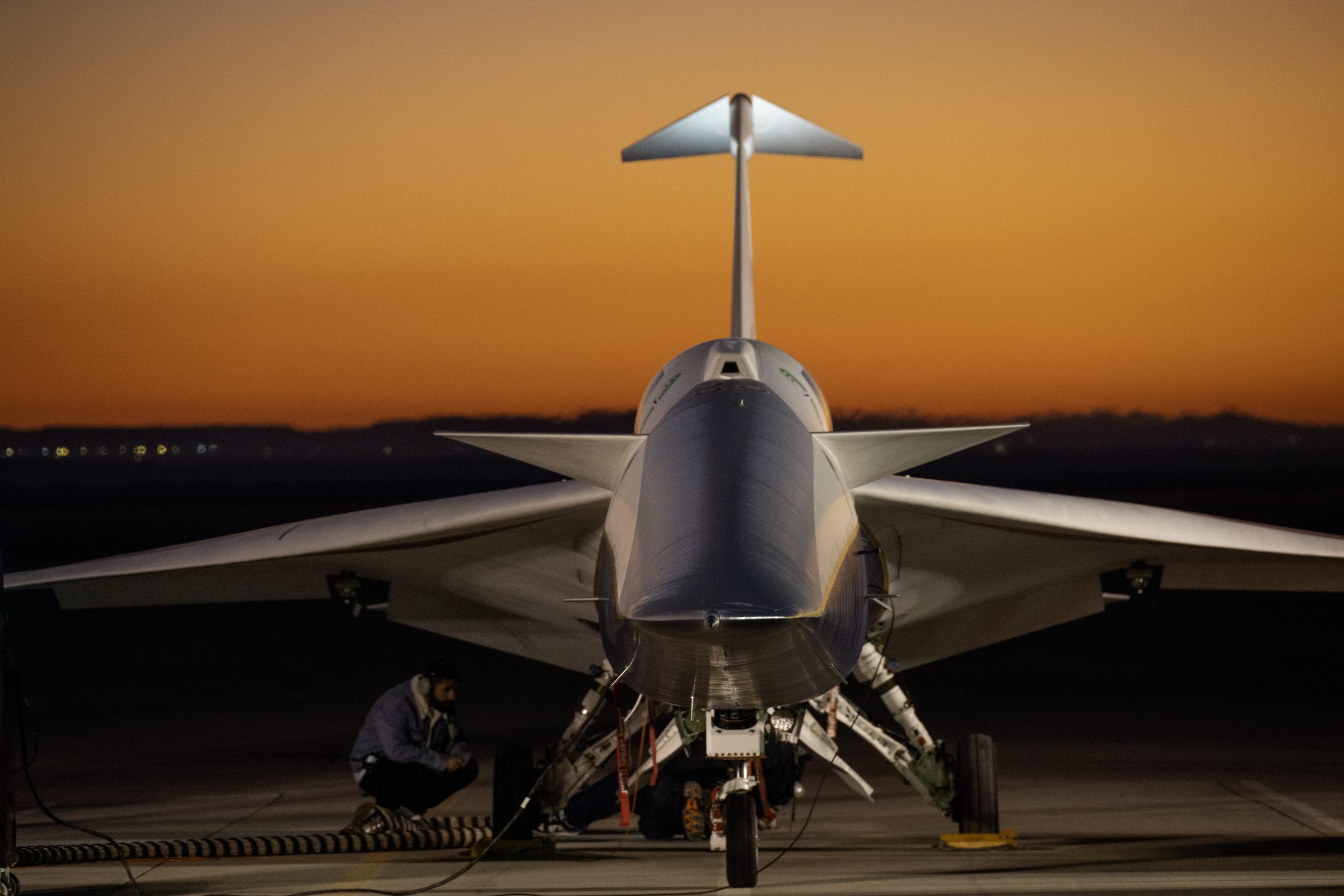
NASA’s X-59 experimental aircraft is preparing for its second flight, a step that will set the pace for more flight testing in 2026.
Over the coming months, NASA will take the quiet supersonic jet faster and higher, while validating safety and performance, a process known as envelope expansion.
NASA test pilot Jim “Clue” Less will be at the X-59’s controls for second flight. Less will take off and land at Edwards Air Force Base, near the X-59’s home at NASA’s Armstrong Flight Research Center in Edwards, California.
“This will be the first time I’ve flown an X-plane,” Less said. “I think I’ll mostly be focused on getting the test cards done and getting them done correctly. It’ll probably sink in later that I was in the X-59.”
Less will be accompanied by NASA test pilot Nils Larson, who will be flying nearby in a NASA F/A-18 aircraft to observe the X-59.
The X-59 made its first flight Oct. 28, 2025, with Larson as pilot. Afterward, NASA and contractor Lockheed Martin completed an extensive round of post-flight maintenance and inspections. The work involved removing the engine, a section of the tail known as the lower empennage, the seat, and more than 70 panels to perform inspections. All have been reinstalled.
“These guys know what they’re doing. We couldn’t do something like this without a really competent team of hardworking folks,” Less said. “Nils trusted them for the first flight. I trust them for the second flight and every flight after that.”
The team completed one of the last ground tests before the flight on March 12 – an engine run firing up the X-59’s modified F-18 Super Hornet F414-GE-100 engine.
“It’s always exciting to see the X-59 come to life on the ground,” said Ray Castner, NASA’s X-59 lead propulsion engineer. “For our team, it’s a moment to pause and appreciate how far this aircraft has come – and how close we are to pushing into the next phase of flight.”
The X-59’s second flight continues the push toward that next phase, with the team closely studying the aircraft’s performance.
“Second flight will look a lot like the first flight,” said Cathy Bahm, NASA’s project manager for the Low Boom Flight Demonstrator project. “We’ll start the flight at a test condition from first flight to ensure X-59 performs as expected after the maintenance phase, then we’ll start the envelope expansion by testing a little higher and faster.”
The flight marks the start of envelope expansion tests for the X-59. After the aircraft reaches a speed of approximately 230 mph at 12,000 feet and its team performs functional checks, it will advance to 260 mph at 20,000 feet.
First flight was the X-59’s biggest leap so far – going from the ground to airborne. Now, envelope expansion will be a gradual process as the aircraft works toward its mission parameters of about 925 mph, or Mach 1.4, at 55,000 feet.
“From here on out, once we’re airborne, we can increase speed and increase altitude in small, measured chunks, looking at things as we go and not getting ahead of ourselves,” Less said. “Eventually we get to supersonic flight – a few more steps – and we’re out to Mach 1.4 at about 55,000 feet,” said Less.
The X-59 is the centerpiece of NASA’s Quesst mission, which aims to usher in a new age of quiet, commercial supersonic flight over land. The X-59 will demonstrate that an aircraft can fly faster than the speed of sound while reducing the typical loud sonic boom to a quieter thump.
Envelope expansion is Phase 1 of Quesst. It will be followed by Phase 2 flight testing to validate the X-59’s acoustic performance. The team will study how the aircraft’s design disperses the shock waves that typically merge into a sonic boom.
After acoustics validation, NASA plans to fly the X-59 over selected U.S. communities to gather data on how people on the ground perceive its quieter sound signature. NASA will share the results with U.S. and international regulators.