


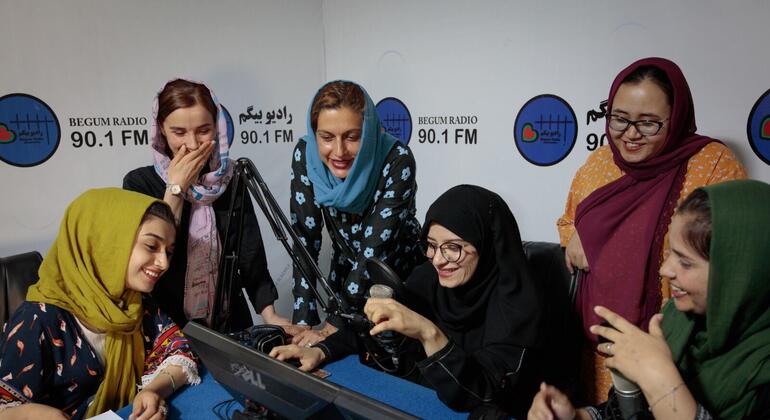
“They don’t come on their own by bus or taxi because it’s very complicated for a woman to move around the city, especially for young women,” station founder Hamida Aman told UN News, explaining the laws preventing them from doing so. Once they arrive at the studio, the journalists hold their editorial meeting, prepare their shows and go live on air.
A Glimmer of Hope Amidst Darkness
Supported by the United Nations Educational, Scientific and Cultural Organization (UNESCO), Radio Begum operates with a team of approximately 30 women. It broadcasts across much of Afghanistan, though authorities have banned women’s voices in the media in about a dozen of the country’s 34 provinces. “Right now, when you are in Afghanistan and you change the channel on television or switch between radio stations, you only hear men’s voices or see images of men,” Ms. Aman stated. In this male-dominated soundscape, Radio Begum offers a unique presence. “Hearing a woman’s voice in this entirely male universe is like a small light, a glimmer in an ocean of darkness.”
Empowering Afghan Women Through Radio
Launched in March 2021, just months before the Taliban’s return to power, Radio Begum was founded by Hamida Aman. Aman, who grew up in Switzerland after fleeing Kabul as a child, returned to Afghanistan to contribute to media development after the fall of the Taliban regime in 2001. Initially, the station featured music, entertainment, and interviews with prominent women, celebrating their achievements over the previous two decades. “Radio Begum is a radio station made for women, by women.” However, the Taliban’s takeover in August 2021 necessitated a rapid shift in content. “Overnight, we had to stop broadcasting music. Overnight, we had to scale back our entertainment programmes.”
Navigating Evolving Restrictions
The months following the Taliban’s return saw a surge in restrictions on women and the media. Women were progressively excluded from many public sector jobs, and female journalists faced stringent conditions, including interviewing only women and avoiding being alone with men in studios. “There were constant warnings and threats,” Ms. Aman recalled. To ensure continued operation, the station adopted a strategy of avoiding political confrontation. “We decided not to do politics. That is one of the reasons why we can continue to work.” A late 2024 decree by the Taliban authorities deeming women’s voices “improper” in public spaces led to bans on female voices in broadcasts in several provinces. “We are a radio station serving women,” Ms. Aman emphasized. “We are no longer an ordinary media outlet.” Consequently, Radio Begum adapted its programming, focusing increasingly on education. “We were pioneers using our airwaves for education.” The station began broadcasting educational lessons in autumn 2021, preceding the widespread ban on girls attending school. This mission became paramount when schools closed to teenage girls. “They closed the schools, yes. School is forbidden, but education is not. So, we will bring school into the home as much as possible.” Currently, Radio Begum broadcasts six hours of educational programming daily, aligned with the Afghan school curriculum, with three hours in Dari and three in Pashto. The station also covers health, psychological support, medical advice, spirituality, women’s entrepreneurship, and social issues like addiction, often live to allow listener interaction.
Promoting Women’s Rights Through an Islamic Lens
Radio Begum addresses women’s rights through an unconventional approach: religious texts. “We inform women about their rights, and we use Islam to do that because it’s the only way,” Ms. Aman explained. Their religious programs draw on Quranic verses, surahs, and hadiths, interpreted by female theologians. “Islam is very precise about the place of women in society,” she noted, citing rules on inheritance, divorce, widows, and education. “We quote the verses, the surahs… so they can’t say anything.” Initially subject to scrutiny by authorities verifying the hosts’ understanding of religious texts, the team was surprised by the positive reception. “They told us it was their favourite programme.” Today, this show is one of the station’s most popular.
Listener Impact and Continued Mission
The station receives numerous calls from listeners nationwide, serving as a “very good barometer of the impact of our programmes.” Demand has led to the extension of shows, particularly those offering psychological support. One listener from Bamiyan province reported successfully asserting her inheritance rights after learning about them on the radio. Another listener shared that her husband’s behavior improved significantly after he heard a program. “My husband listened to the programme and since then, he behaves much better and he is much kinder.” These testimonials, Ms. Aman shared, provide encouragement and comfort. Despite these successes, the challenges remain immense. “Being an Afghan woman means a lot of constraints and a lot of worries.” Radio Begum strives to provide a vital space for expression and support. “We are responding to needs that the government should provide for women, but since this government has decided to ignore 50 per cent of its population, we have to step in.” In a nation where women face increasing exclusion from public life, Radio Begum continues to broadcast, offering a rare platform for women to be heard.