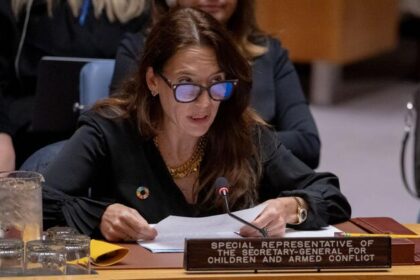


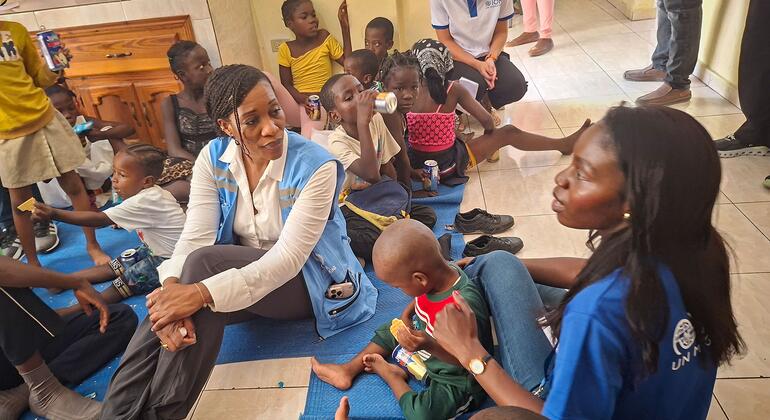
Edem Wosornu of the UN humanitarian affairs office (OCHA) briefed journalists on her recent mission to Haiti, where violent armed gangs continue to control significant portions of the nation. The escalating crisis is characterized by heightened insecurity, increasing protection needs, widespread displacement, alarming levels of gender-based violence (GBV), and a challenging operational environment for the UN and its partners.
OCHA is issuing an urgent warning as over half of Haiti’s population, amounting to 6.4 million people, now require humanitarian assistance. Approximately 5.7 million individuals are experiencing hunger, with families forced to skip meals and children leaving school to contribute to household support. Furthermore, 1.5 million people, or 12 percent of the population, have been displaced.
“These are not abstract figures. These represent families uprooted, families displaced; separated children – many who’ve lost the homes that they knew,” Wosornu stated.
Violence and Displacement in Port-au-Prince and Beyond
Ms. Wosornu, Director of OCHA’s Crisis Response Division, noted that the situation in Haiti has dramatically worsened since her previous mission two years ago. She visited the capital, Port-au-Prince, which is reportedly 90 percent under gang control, as well as the Centre Department. In the latter, a recent wave of violence resulted in approximately 80 deaths and forced 13,000 people to flee their homes.
During her visit, the humanitarian official toured crowded displacement sites. She described one school, normally accommodating 400 students, now sheltering around 2,800 people. “They described at night vermin, roaches, coming out; rashes on the skin of children,” she recounted. “The very ground I was walking on (was) the very place people were sleeping on at night.”
Across Haiti, 1,600 schools remain closed due to insecurity, a significant blow to a country that highly values education. “School means a lot for the people of Haiti. So, 1,600 schools closed, 250,000 children missing education, is a big, huge deal,” Ms. Wosornu emphasized.
Protecting Women and Girls Amidst Crisis
The situation for women and girls in Haiti is described as a particularly horrendous protection crisis. Last year, 8,100 survivors of gender-based violence were recorded, marking a 25 percent increase from the previous year, with half of reported cases involving rape. Ms. Wosornu shared the story of a 16-year-old girl with a three-month-old baby, whom she called “a child holding a child.” The teenager, displaced and separated from her family, was abused after accepting help from a man. Alarmingly, one in six GBV survivors are under 18.
Ms. Wosornu also spoke with women whose trauma was evident in their expressions. However, only 30 percent of survivors receive essential medical or psychological support within the critical 72-hour window following sexual violence, largely due to insufficient humanitarian funding for GBV response.
Humanitarian Commitment and Funding Shortfalls
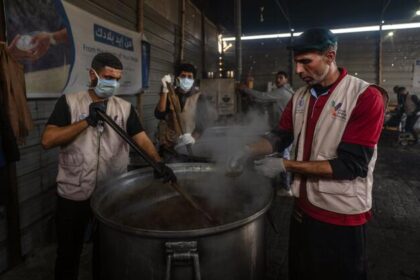
Despite the severe devastation, the UN and its humanitarian partners remain committed to assisting the Haitian population. Aid teams include national staff who, despite being displaced and under threat themselves, continue their critical work. “They sometimes negotiate with the very armed actors that we are talking about, delivering assistance in areas that are extremely difficult to reach,” Wosornu explained.
Humanitarian organizations are seeking $880 million to aid 4.2 million people in Haiti this year, facing ongoing cuts to foreign aid. To date, less than 20 percent of the required funding has been received.
Urgent Call for Action: Haiti Cannot Wait
Concluding her briefing, Ms. Wosornu made three urgent requests, emphasizing that “the people of Haiti cannot wait.” She called for an immediate end to the violence, continued support for collapsing humanitarian operations, and political solutions to resolve the ongoing crisis. “We must be honest. Humanitarian assistance alone cannot change the fate of the people of Haiti and the trajectory of Haiti,” she stated. “Sustained investment in essential services can create solutions for the people. Haiti’s courage, undeniable. Our support, ever so necessary.”