

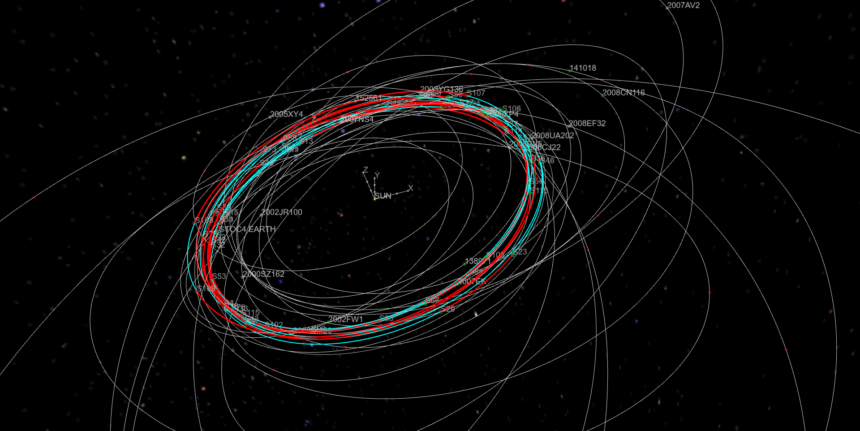
Copernicus, a versatile spacecraft trajectory design and optimization system, is equipped to address a broad spectrum of trajectory challenges. These include planet or moon-centered trajectories, libration point trajectories, planet-moon transfers and tours, and various interplanetary and asteroid/comet missions.
Key Milestones and Updates
- May 26, 2026: Copernicus Version 5.4.1, a bugfix release with new features, is now available.
- March 23, 2026: Copernicus Version 5.4 introduces numerous new features, enhancements, and bug fixes. Notably, it offers native support for Macs with Apple Silicon processors. Enhancements include new altitude and eclipse ramping/buffer engine model options, a new propagation model for simulating finite burn segments, a new circular restricted three-body problem (CR3BP) parameterization and propagation mode, upgraded shadowing/eclipse models, new two-body rotating frame definition options, significant GUI improvements, and expanded Copernicus Python API capabilities.
- August 13, 2024: Copernicus Version 5.3.2 has been released.
- December 18, 2023: Copernicus Version 5.3.1, a bugfix release, is now available.
- November 15, 2023: Copernicus Version 5.3 includes many bug fixes, new features, and refinements. Key updates feature a new Copernicus mission file format, updated kernels, an expanded beta Python API, and new integration methods. The system has been upgraded to Python 3.10, with all dependencies managed via conda.
- January 21, 2022: Copernicus Version 5.2 is available, offering numerous bug fixes and new features.
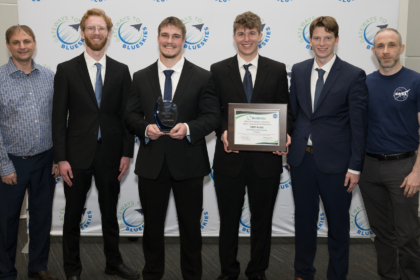
- June 17, 2021: Copernicus received the 2021 NASA Software of the Year Award.
- March 4, 2021: Copernicus Version 5.1 has been released with many bug fixes and new features.
- June 26, 2020: Copernicus Version 5.0 marks a significant update, introducing a new cross-platform Python-based GUI for Windows, Linux, and macOS. It also features 3D graphics upgrades including antialiasing and celestial body shadowing, a new Python scripting interface, and numerous other enhancements and bug fixes.
- May 1, 2018: Copernicus Version 4.6 includes a new cross-platform JSON kernel file format, enhanced reference frame features with user-defined plugin capabilities, and minor enhancements.
- January 24, 2018: Copernicus Version 4.5 offers an experimental Mac version, faster segment data export with a new HDF5 format, new GUI tools, plugin capabilities, and other features.
- October 1, 2016: Copernicus Version 4.4 brings 3D graphics improvements and various other new features.
- February 8, 2016: Copernicus Version 4.3 updates the plugin interface, adds a new differential corrector solution method, includes updated SPICE SPK files, Python interface updates, new training videos, and other refinements.
- July 21, 2015: Copernicus Version 4.2 provides further refinements to the plugin feature and includes new features and bug fixes.
- April 13, 2015: Copernicus Version 4.1 introduces a new plugin architecture for extending functionality with user-created algorithms, a new Python interface, and other enhancements.
- August 13, 2014: Copernicus Version 4.0, an update to version 3.1, offers many new features, bug fixes, performance improvements, a redesigned GUI, a new user guide, and full Windows 7 compatibility.
Project Origins and Development
The Copernicus Project originated at the University of Texas at Austin in August 2001. Development of the first prototype, supported by a NASA Johnson Space Center (JSC) grant, was completed in August 2004. Additional support was provided by NASA’s In Space Propulsion Program and the Flight Dynamics Vehicle Branch of Goddard Spaceflight Center. The first operational version (v1.0) was completed in March 2006. The initial development team comprised Dr. Cesar Ocampo and graduate students from the University of Texas at Austin’s Department of Aerospace Engineering and Engineering Mechanics. Since March 2007, primary development has been led by the Flight Mechanics and Trajectory Design Branch at JSC.
Technology Transfer and Availability
The National Aeronautics and Space Act of 1958 and subsequent legislation emphasize the national priority of transferring federally owned technology. In line with NASA’s obligations, JSC makes Copernicus available free of charge to other NASA centers, government contractors, and universities under a US government purpose license. Organizations interested in obtaining Copernicus can request it via this link.
The current version of Copernicus is 5.4.1, released on May 26, 2026.
Publications and Technical Papers
- C. A. Ocampo, “An Architecture for a Generalized Trajectory Design and Optimization System”, Proceedings of the International Conference on Libration Points and Missions, June, 2002.
- C. A. Ocampo, “Finite Burn Maneuver Modeling for a Generalized Spacecraft Trajectory Design and Optimization System”, Annals of the New York Academy of Science, May 2004.
- C. A. Ocampo, J. Senent, “The Design and Development of Copernicus: A Comprehensive Trajectory Design and Optimization System”, Proceedings of the International Astronautical Congress, 2006. IAC-06-C1.4.04.
- R. Mathur, C. A. Ocampo, “An Architecture for Incorporating Interactive Visualizations into Scientific Simulations”, Advances in the Astronautical Sciences, Feb. 2007.
- C. A. Ocampo, J. S. Senent, J. Williams, “Theoretical Foundation of Copernicus: A Unified System for Trajectory Design and Optimization”, 4th International Conference on Astrodynamics Tools and Techniques, May 2010.
- J. Williams, J. S. Senent, C. A. Ocampo, R. Mathur, “Overview and Software Architecture of the Copernicus Trajectory Design and Optimization System”, 4th International Conference on Astrodynamics Tools and Techniques, May 2010.
- J. Williams, J. S. Senent, D. E. Lee, “Recent Improvements to the Copernicus Trajectory Design and Optimization System”, Advances in the Astronautical Sciences, 2012.
- J. Williams, “A New Architecture for Extending the Capabilities of the Copernicus Trajectory Optimization Program”, Advances in the Astronautical Sciences, 2015, volume 156.
- J. Williams, R. D. Falck, and I. B. Beekman. “Application of Modern Fortran to Spacecraft Trajectory Design and Optimization“, 2018 Space Flight Mechanics Meeting, AIAA SciTech Forum, (AIAA 2018-1451)
- J. Williams, A. H. Kamath, R. A. Eckman, G. L. Condon, R. Mathur, and D. Davis, “Copernicus 5.0: Latest Advances in JSC’s Spacecraft Trajectory Optimization and Design System”, 2019 AAS/AIAA Astrodynamics Specialist Conference, Portland, ME, August 11-15, 2019, AAS 19-719
- J. Williams, J. S. Senent, R. Mathur, and S. M. Stewart, “A History of Copernicus: The Origin, Development, and Evolution of JSC’s Spacecraft Trajectory Design and Optimization System”, AAS/AIAA Astrodynamics Specialist Conference, Boston, MA, August 2025, AAS 25-576.
Related Publications
- C. L. Ranieri, C. A. Ocampo, “Optimization of Roundtrip, Time-Constrained, Finite Burn Trajectories via an Indirect Method”, Journal of Guidance, Control, and Dynamics, Vol. 28, No. 2, March-April 2005.
- T. Polsgrove, L. Kos, R. Hopkins, T. Crane, “Comparison of Performance Predictions for New Low-Thrust Trajectory Tools”, AIAA/AAS Astrodynamics Specialist Conference, August, 2006.
- L. D. Kos, T. P. Polsgrove, R. C. Hopkins, D. Thomas and J. A. Sims, “Overview of the Development for a Suite of Low-Thrust Trajectory Analysis Tools”, AIAA/AAS Astrodynamics Specialist Conference, August, 2006.
- M. Garn, M. Qu, J. Chrone, P. Su, C. Karlgaard, “NASA’s Planned Return to the Moon: Global Access and Anytime Return Requirement Implications on the Lunar Orbit Insertion Burns”, AIAA/AAS Astrodynamics Specialist Conference and Exhibit, August, 2008.
- R. B. Adams, “Near Earth Object (NEO) Mitigation Options Using Exploration Technologies”, Asteroid Deflection Research Symposium, Oct. 2008.
- J. Gaebler, R. Lugo, E. Axdahl, P. Chai, M. Grimes, M. Long, R. Rowland, A. Wilhite, “Reusable Lunar Transportation Architecture Utilizing Orbital Propellant Depots”, AIAA SPACE 2009 Conference and Exposition, September 2009.
- J. Williams, E. C. Davis, D. E. Lee, G. L. Condon, T. F. Dawn, “Global Performance Characterization of the Three Burn Trans-Earth Injection Maneuver Sequence over the Lunar Nodal Cycle”, Advances in the Astronautical Sciences, Vol. 135, 2010. AAS 09-380
- J. Williams, S. M. Stewart, D. E. Lee, E. C. Davis, G. L. Condon, T. F. Dawn, J. Senent, “The Mission Assessment Post Processor (MAPP): A New Tool for Performance Evaluation of Human Lunar Missions”, 20th AAS/AIAA Space Flight Mechanics Meeting, Feb. 2010.
- J. W. Dankanich, L. M. Burke, J. A. Hemminger, “Mars sample return Orbiter/Earth Return Vehicle technology needs and mission risk assessment”, 2010 IEEE Aerospace Conference, March 2010.
- A. V. Ilin, L. D. Cassady, T. W. Glover, M. D. Carter, F. R. Chang Diaz, “A Survey of Missions using VASIMR for Flexible Space Exploration”, Ad Astra Rocket Company, Document Number JSC-65825, April 2010.
- J. W. Dankanich, B. Vondra, A. V. Ilin, “Fast Transits to Mars Using Electric Propulsion”, 46th AIAA/ASME/SAE/ASEE Joint Propulsion Conference & Exhibit, July 2010.
- S. R. Oleson, M. L. McGuire, L. Burke, J. Fincannon, T. Colozza, J. Fittje, M. Martini, T. Packard, J. Hemminger, J. Gyekenyesi, “Mars Earth Return Vehicle (MERV) Propulsion Options”, 46th AIAA/ASME/SAE/ASEE Joint Propulsion Conference & Exhibit, July 2010, AIAA 2010-6795.
- J. S. Senent, “Fast Calculation of Abort Return Trajectories for Manned Missions to the Moon”, AIAA/AAS Astrodynamics Specialist Conference, August 2010.
- D. S. Cooley, K. F. Galal, K. Berry, L. Janes, G. Marr. J. Carrico. C. Ocampo, “Mission Design for the Lunar CRater Observation and Sensing Satellite (LCROSS)”, AIAA/AAS Astrodynamics Specialist Conference, August, 2010.
- A. V. Ilin, L. D. Cassady, T. W. Glover, F. R. Chang Diaz, “VASIMR Human Mission to Mars”, Space, Propulsion & Energy Sciences International Forum, March 15-17, 2011.
- J. Brophy, F. Culick, L. Friedman, et al., “Asteroid Retrieval Feasibility Study,” Technical Report, Keck Institute for Space Studies, California Institute of Technology, Jet Propulsion Laboratory, April 2012.
- A. V. Ilin, “Low Thrust Trajectory Analysis (A Survey of Missions using VASIMR for Flexible Space Exploration – Part 2), Ad Astra Rocket Company, Document Number JSC-66428, June 2012.
- P. R. Chai, A. W. Wilhite, “Station Keeping for Earth-Moon Lagrangian Point Exploration Architectural Assets”, AIAA SPACE 2012 Conference & Exposition, September, 2012, AIAA 2012-5112.
- F. R. Chang Diaz, M. D. Carter, T. W. Glover, A. V. Ilin, C. S. Olsen, J. P. Squire, R. J. Litchford, N. Harada, S. L. Koontz, “Fast and Robust Human Missions to Mars with Advanced Nuclear Electric Power and VASIMR Propulsion”, Proceedings of Nuclear and Emerging Technologies for Space, Feb. 2013. Paper 6777.
- J. Williams, “Trajectory Design for the Asteroid Redirect Crewed Mission”, JSC Engineering, Technology and Science (JETS) Contract Technical Brief JETS-JE23-13-AFGNC-DOC-0014, July, 2013.
- J.P. Gutkowski, T.F. Dawn, R.M. Jedrey, “Trajectory Design Analysis over the Lunar Nodal Cycle for the Multi-Purpose Crew Vehicle (MPCV) Exploration Mission 2 (EM-2)”, Advances in the Astronautical Sciences Guidance, Navigation and Control, Vol. 151, 2014. AAS 14-096.
- R. G. Merrill, M. Qu, M. A. Vavrina, C. A. Jones, J. Englander, “Interplanetary Trajectory Design for the Asteroid Robotic Redirect Mission Alternate Approach Trade Study”, AIAA/AAS Astrodynamics Specialist Conference, 2014. AIAA 2014-4457.
- J. Williams, G. L. Condon. “Contingency Trajectory Planning for the Asteroid Redirect Crewed Mission”, SpaceOps 2014 Conference (AIAA 2014-1697).
- J. Williams, D. E. Lee, R. J. Whitley, K. A. Bokelmann, D. C. Davis, and C. F. Berry. “Targeting cislunar near rectilinear halo orbits for human space exploration“, AAS 17-267
- T. F. Dawn, J. Gutkowski, A. Batcha, J. Williams, and S. Pedrotty. “Trajectory Design Considerations for Exploration Mission 1“, 2018 Space Flight Mechanics Meeting, AIAA SciTech Forum, (AIAA 2018-0968)
- A. L. Batcha, J. Williams, T. F. Dawn, J. P. Gutkowski, M. V. Widner, S. L. Smallwood, B. J. Killeen, E. C. Williams, and R. E. Harpold, “Artemis I Trajectory Design and Optimization”, AAS/AIAA Astrodynamics Specialist Conference, August 9-12, 2020, AAS 20-649