

NASA relies on its aircraft to perform at their peak for high-speed research flights and high-altitude science campaigns. Ensuring these aircraft are always mission-ready falls to the dedicated ground crews at NASA’s Armstrong Flight Research Center in Edwards, California. These specially trained maintenance teams are crucial for the safe and reliable operation of the agency’s diverse fleet.
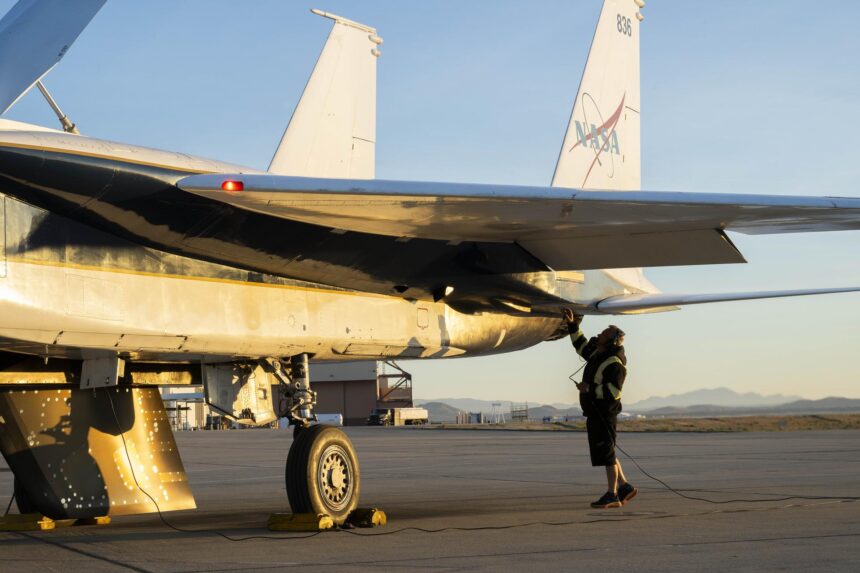
This year, NASA expanded its Armstrong fleet with the addition of two F-15 aircraft and a Pilatus PC-12. These new platforms join existing assets like the high-altitude ER-2s and the cutting-edge X-59, NASA’s newest X-plane. The maintenance staff bears the responsibility of keeping every aircraft in the fleet prepared for its specific mission.
Jose “Manny” Rodriguez, NASA Armstrong Gulfstream G-IV crew chief, highlighted the adaptability of his teams: “That’s the beauty of our Armstrong maintenance teams. They adapt to any type of change. One day you could have an instrument being loaded, and the next day it may be aircraft reconfiguration, all while other aircraft systems may need fixing. They adapt and they overcome any situation.”
Each aircraft is tailored for distinct roles, from conducting scientific research and serving as support or chase aircraft to aiding in NASA rocket launches. Operating at various speeds and carrying specialized equipment necessitates that maintenance crews remain agile and responsive to rapid operational shifts.
To facilitate NASA’s advancements in aeronautics and science, these crews work tirelessly. Their tasks include continuous checks on ejection seats, refueling, and the constant replacement of components like brakes, wheels, wiring, and hardware, all of which experience wear with each flight.
On any given day, an aircraft might be ready for immediate deployment, undergoing scheduled maintenance or modifications, or be in for longer-term servicing. NASA Armstrong aircraft are frequently in the air simultaneously. For instance, the center’s C-20A is currently operating in Peru and Panama, the X-59 is often flown twice daily with a chase plane, and the ER-2 is flying in Colorado to support the Geological Earth Mapping Experiment (GEMx). Throughout these simultaneous operations, Armstrong’s skilled maintenance staff works diligently to prepare and repair aircraft as needed.
The maintenance team comprises individuals with both military and civilian backgrounds, with significant on-the-job training forming a core part of their development. The team structure includes:
- A crew chief, who holds overall responsibility for the aircraft.
- An avionics technician, specializing in navigation, communication, and flight control systems.
- Quality assurance personnel, tasked with overseeing the maintenance work.
- Additional mechanics assigned to support each specific aircraft.
Once the maintenance crew confirms an aircraft is in optimal condition, it is moved to the flightline, ready for operations. The assigned NASA pilot will conduct a final safety inspection with the crew chief before each flight.
Rodriguez emphasized the critical role of the crew chief: “There is a crew chief assigned to every aircraft. The crew chief is responsible for the integrity of that aircraft, and at the end of the day, his signature and the pilot’s together are what constitutes that the aircraft is safe for flight.”
Maintenance crews meticulously track each flight to ensure mission completion without premature returns. Should an aircraft land early, the maintenance team is on standby. Upon landing, they are immediately available to assist the research team in completing the mission and perform necessary repairs, maintaining agility for the next flight.
“It’s difficult at times to work with different airplanes from both the civilian and military sides, but it’s very rewarding to see that we have the capability and the expertise to keep these aircraft flying,” Rodriguez added.