

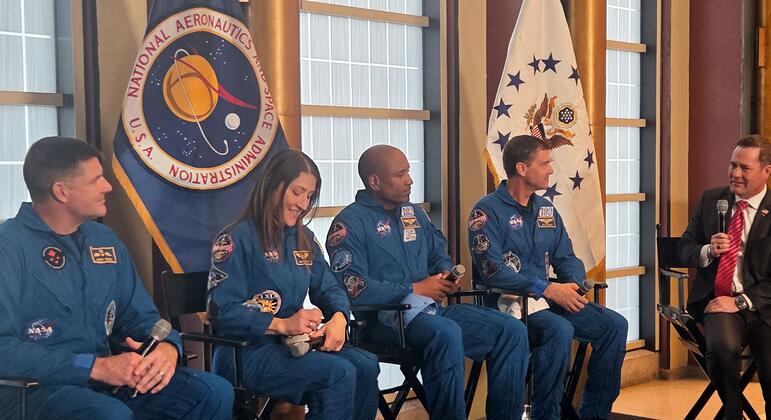
The Artemis II astronauts continued a long-standing tradition of spacefarers visiting the United Nations on Thursday, addressing themes of peace, international cooperation, and humanity’s shared global future. This visit followed their historic 10-day mission, which marked the farthest human spaceflight ever, venturing beyond the far side of the Moon before a safe return to Earth. During their time in space, the crew, as noted at the event, “captured the imagination of billions” and reignited a collective human spirit in space exploration.
Tradition and Continuity in Space Exploration
The UN General Assembly has a history of welcoming space age pioneers. This tradition began with Soviet cosmonauts Yuri Gagarin and Valentina Tereshkova, the first man and woman in space. Their visit in October 1963 was symbolic of both technological advancement and the potential for unity in space. Since then, representatives from various nations have spoken at the UN, emphasizing that space exploration necessitates cooperation and shared responsibility.
The Artemis II mission upholds this legacy, representing not only a technological leap but also a model of international partnership. The mission involves numerous countries and institutions, including the European Space Agency, with scientific instruments and systems developed by global specialists. U.S. Ambassador Mike Waltz, who hosted the discussion, noted the crew’s exceptional nature, describing them as “pretty normal but pretty overachieving Americans and a Canadian.” The astronauts stressed that their mission aimed to test the spacecraft and, crucially, to remind humanity of its capacity for great achievements when working collaboratively.
Perspective from Deep Space
For the Artemis II astronauts, the most profound experience was viewing Earth from deep space. From hundreds of thousands of miles away, the planet appeared small, fragile, and seemingly weightless against the immense darkness of space. This perspective underscored the Earth’s uniqueness and the preciousness of life itself. Pilot Victor Glover expressed a deep sense of gratitude for what they witnessed and for the planet they would return to. Astronaut Christina Koch shared a realization of humanity’s place within the vast universe, noting, “You realize that actually there’s nothing absolute or guaranteed about this, and that actually there is such thing as a global scale…this scale is our world and what we do with it is our choice.”
Life Aboard the Spacecraft
Life within the spacecraft presented significant challenges, requiring the crew to meticulously balance experiments, navigation, system monitoring, and adaptation to microgravity. Canadian astronaut Jeremy Hansen recounted a humorous incident involving a granola bar package that burst, scattering berries onto Victor Glover. Hansen recalled Glover’s lighthearted response: “Oh, don’t worry, I got this”. And he takes a spoon and he just starts eating it off of his shirt.”
The Artemis Program: A Return to the Moon and Beyond
Artemis II is the initial phase of a larger initiative aiming to return humans to the Moon, establish a lasting presence, and construct infrastructure, including a lunar base, to support ongoing exploration. These ambitious plans are guided by the Artemis Accords, a framework of international principles already adopted by numerous countries. Speaking at the UN, the astronauts encouraged young people to remain curious and attentive listeners. They concluded by emphasizing that the significance of Artemis II extends beyond distance or technological accomplishments. Space provides a unique vantage point, revealing Earth as a singular, shared home that requires care and has the potential to unite people. Reid Wiseman summarized this sentiment: “Everyone asks what the Earth looks like from space, and most of the time I reply, the tiny Earth is an incredible place.”
Meanwhile, NASA aerospace engineer Alinda Mashiku, who grew up in Tanzania with astronaut aspirations, now contributes to space mission safety as a Program Manager, ensuring satellite collision avoidance for missions like Artemis II.