

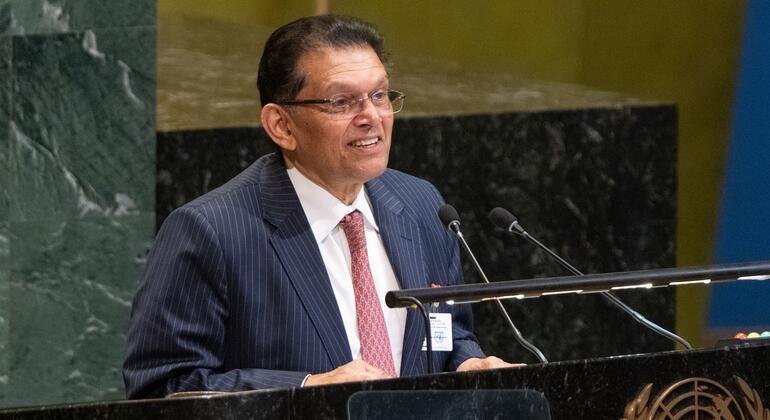
In a secret ballot held at the United Nations General Assembly, Bangladesh’s Khalilur Rahman secured the presidency by winning 99 votes against his opponent Kakouris. A total of 190 valid votes were cast, with no invalid or abstention votes.
The presidency, which rotates among the UN’s five regional groups, fell to the Asia-Pacific group for the 81st session. Rahman will serve a one-year term, commencing on September 8.
Rahman’s presidency coincides with a pivotal period in the UN calendar: the selection of a new Secretary-General to succeed António Guterres, whose current term concludes on December 31, 2026.
With over four years of diplomatic and multilateral experience, Rahman had been serving as Bangladesh’s Foreign Minister since February. He previously held roles as National Security Advisor and High Representative on the Rohingya Issue.
A career diplomat, Rahman joined the Bangladesh foreign service in 1979. He also held senior UN positions in New York and Geneva.
‘With Humility and Respect’
Accepting his new role, Rahman stated he was taking on the position “with humility and respect” during a time when trust in the international system is being tested.
“The UN, as it enters its ninth decade, is at a juncture where trust in our founding principles is being tested on many fronts,” Rahman said.
“These challenges tend to weaken public confidence and belief in our founding organization’s ability to deliver on its promises.”
A World Under Pressure
The election took place during what current General Assembly President Annalena Baerbock described as an exceptionally challenging period for multilateral diplomacy.
Addressing member states, Baerbock noted that the UN is facing “not just headwinds, but immense pressure,” with consensus becoming increasingly difficult and defending the UN Charter a “daily necessity.”.
“The role of the President of the General Assembly is no longer merely procedural,” Baerbock added.
Future Challenges
Baerbock warned that the international landscape would not become easier in the coming year, as the General Assembly continues its work on implementing the Pact for the Future, advancing reform efforts through the UN80 initiative, and overcoming broader geopolitical divides.
Secretary-General António Guterres echoed these concerns, stating that the world is grappling with “conflicts, divisions, rising inequality and climate chaos.”.
He also pointed to the slowdown in progress on the Sustainable Development Goals (SDGs), declining humanitarian and development funding, and international institutions being “stuck in the world of 1945, not the world of today.”.
Six Priorities for the 81st Session
Rahman outlined that his presidency would focus on six broad priorities: peace and security; accelerating progress on the SDGs; climate action and environmental protection; human rights; governance of emerging technologies, including artificial intelligence; and UN reform.
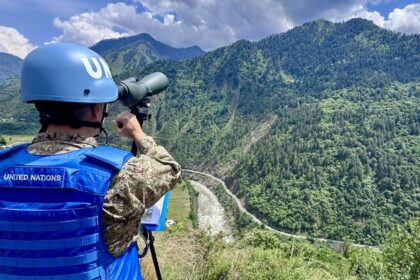
He pledged to leverage Bangladesh’s peacekeeping experience to support preventive diplomacy, peacebuilding, and civil protection.
He also highlighted the need to address development finance gaps, advance the implementation of the Global Digital Compact, and strengthen the UN’s effectiveness at a time of increasing pressure on multilateral institutions.
‘Rebuilding Trust’
The overarching theme for Rahman’s session is “Rebuilding Trust, Managing Transformation: A UN Delivering for All”.
Secretary-General Guterres hailed this theme as an “inspiring call to action for the multilateral system,” reflecting a commitment to strengthening global cooperation.
The newly elected President expressed his intention to act as a bridge-builder, pledging to engage with all member states and seek common ground despite growing divisions.
“As your President, I will dedicate myself to rebuilding trust, fostering consensus, and opening space for good-faith negotiations that lead to outcomes owned by all,” Rahman stated.
He also committed to upholding the UN Charter, maintaining geographic and gender balance in his office, and supporting the needs of smaller delegations.
The General Assembly is the UN’s most representative body, bringing together all 193 member states, each with one vote.
While its decisions are generally not legally binding, the Assembly serves as the primary forum for international negotiations on peace and security, development, human rights, and international law.
The 81st session is set to open on September 8, with world leaders convening for their annual high-level debate at UN Headquarters in New York two weeks later.