

A team of Cornell University students is gaining recognition for their groundbreaking research aimed at creating a national air transportation management system capable of safely integrating thousands of drones. NASA is supporting this initiative through the University Student Research Challenge (USRC), a program that provides grants to college students contributing to the agency’s aeronautical research objectives.
Mehrnaz Sabet, a doctoral student in information science and the principal investigator for the grant, highlighted that while managing drone traffic is not a new concept, NASA has been a long-time leader in this field. The USRC program now offers Sabet and her team a platform to introduce innovative solutions for drone safety and air traffic management, leveraging their fresh perspectives and ideas.
The ultimate goal of Cornell’s research is to facilitate the full realization of advanced air mobility (AAM), encompassing a range of applications from urban air taxis and enhanced disaster response aircraft to drone delivery services. This work also underscores NASA’s commitment to advancing cutting-edge technologies and cultivating its future workforce through programs like USRC.
Parimal Koperdekar, acting director of NASA’s Airspace Operations and Safety Program, praised the team’s diverse skill set, noting their proficiency in software, algorithms, hardware, sensor development, laboratory tests, simulations, and actual flight tests as a rare and valuable combination.
Currently, drone operators are required to submit detailed flight plans to a traffic management service, which are then cross-referenced to prevent collisions—a process Sabet describes as strategic deconfliction. However, the existing air traffic management system faces limitations in handling the projected increase in aerial vehicles. Sabet explained that the current system risks being overwhelmed by the sheer volume of drones expected in the coming years.
Sabet drew an analogy to road traffic, where millions of vehicles navigate daily without individual pre-coordination. Instead, traffic laws and infrastructure manage interactions. The proposed drone system aims to incorporate similar flexibility, allowing drones to adapt their flight paths dynamically while still adhering to basic flight plans.
“We need to ensure all these different types of drones can tactically deconflict with each other so that it is safe for them to operate like cars do on the ground. And that missing piece – tactical deconfliction – is at the center of our project,” Sabet stated.
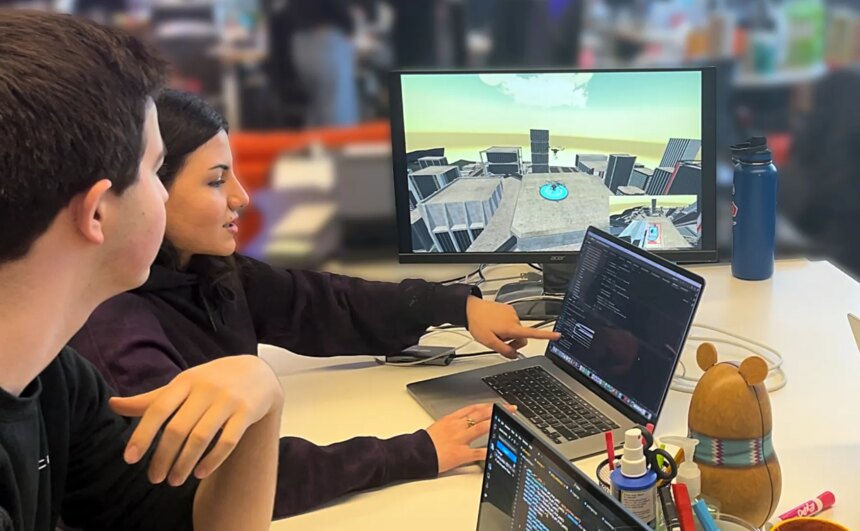
The core of the Cornell team’s research involves integrating simulated and real-world environments to test and demonstrate how drones can adapt to hazardous conditions and autonomously adjust their flight paths. Facing limitations in conducting large-scale flight tests, the students developed a virtual urban environment to evaluate high-volume traffic models and separation algorithms.
“Our first year of the project went into adapting and scaling that simulation engine and it all went very well,” Sabet shared. “But we didn’t want to stick to a simulation. We wanted to see how the simulation translated to the real world, which mattered more.”
To bridge the gap between simulation and reality, the team embedded the simulation into a real drone. This allowed the drone to operate as if it were in a dense urban environment, even while flying in an open field. This approach enabled the team to test traffic management tools and assess how drones could coordinate course corrections and avoid collisions.
In the past year, the team advanced their work by flying two real drones simultaneously, each equipped with the real-time simulation. This allowed the drones to coordinate and perceive both simulated and each other’s presence within an integrated test environment. “We would then intentionally put them on a direct collision course to stress-test the detect and avoid and coordination models and see how well they react and coordinate the drone’s maneuvers to avoid hitting each other,” Sabet explained.
Their success has garnered attention from NASA experts in Unmanned Aircraft Systems Traffic Management (UTM). Kopardekar noted the impressive scope of Cornell’s study, which included over 10,000 runs, more than one million trajectories, and over 200,000 hours of experimentation focused on decentralized coordination for safe operations.
Industry and the Federal Aviation Administration (FAA) have also responded positively. The team was tasked with virtually recreating a 2025 drone collision incident in Arizona, demonstrating how such an accident could have been prevented. Additionally, they simulated recent wildfires in California to illustrate how drones could improve situational awareness for public safety officials and avoid interfering with fire-suppressing air tankers.
The FAA is reportedly interested in applying the project’s mixed-reality testing methodology to evaluate drone operations under increasing complexity. “This kind of mixed-reality type of operational complexity enables them to test drone operations in a way that was not possible before,” Sabet remarked.
With continued support from NASA’s USRC, the Cornell team aims to expand their capabilities and manage increasingly complex advanced air mobility operations. “Our goal is to build the foundational systems that enable safe, large-scale autonomy in the skies,” Sabet concluded.