

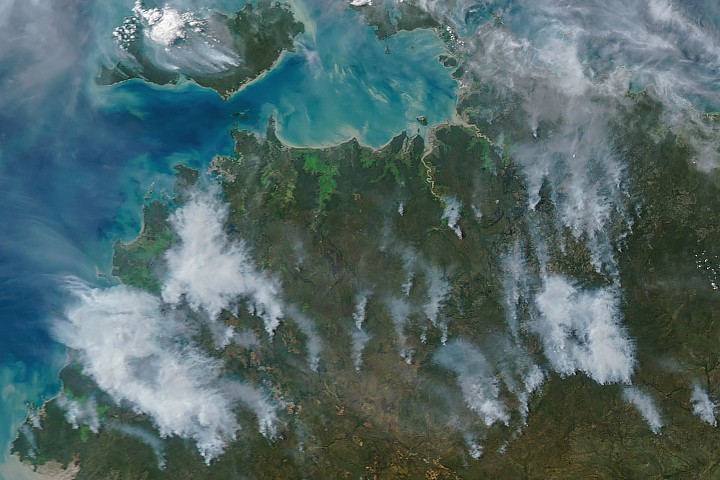
NASA satellites are providing crucial observations of wildland fires in Australia’s Northern Territory, specifically in the Top End and Arnhem Land regions, throughout May and June. While some fires, like one captured by the Aqua satellite on May 28, 2026, can appear as large wildfires with significant smoke plumes, many fires observed are often smaller and less severe.
The observed intensity patterns, with fires appearing more pronounced in the afternoon compared to the morning, are characteristic of prescribed burns. Land managers typically start these controlled fires in the morning to manage the landscape. Smoke accumulation throughout the day, sometimes creating substantial plumes when influenced by updrafts and moderate winds, was noted on May 28 and June 2. These controlled burns are implemented to manage the fire-adapted vegetation within the region’s tropical savanna ecosystems.
For many years, land managers in the Northern Territory have integrated traditional Indigenous knowledge with contemporary technology for extensive landscape management. Projects such as the West Arnhem Land Fire Abatement and Arnhem Land Fire Abatement are designed to strategically burn underbrush during the early dry season, typically from May to September. This practice establishes firebreaks and reduces fuel loads, ultimately lowering the likelihood of more destructive, high-emission fires later in the season.
Satellite data indicates that these prescribed burning initiatives are proving effective. Research suggests a notable shift in fire activity from the late dry season to the earlier part of the dry season, leading to a decrease in high-intensity fires and their associated emissions.