

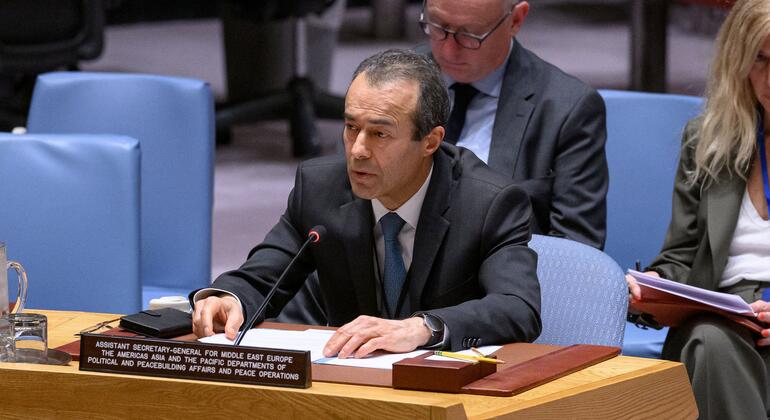
United Nations Assistant Secretary-General for Political Affairs, Khaled Khiari, emphasized the critical role of European Union support for the UN during the Security Council’s annual debate on cooperation between the two organizations in peace and security matters. “In an increasingly complex and uncertain international environment, sustained engagement, dialogue and trust-building are essential,” Khiari stated, adding that respect for international law and the UN Charter is fundamental to addressing shared challenges, with the EU playing a significant role in advancing these principles.
Partner in Peace and Security
Khiari highlighted the EU as a key partner across the UN’s diverse work, encompassing international peace and security, human rights, sustainable development, and humanitarian action. He specifically acknowledged the contributions of EU member states as troop and police-contributing countries, particularly in challenging regions like Lebanon. “At a time when advancing political solutions remains difficult in many contexts, the support of the European Union to the United Nations’ good offices, mediation and political engagement is especially important,” he noted.
Hopes for Ukraine Ceasefire
Addressing the war in Ukraine, Khiari described it as a severe test for regional frameworks related to the international order, stating that Russia’s invasion has profoundly shaken European security architecture. As the conflict enters its fifth year with a rising human toll, he expressed hope that an Orthodox Easter temporary ceasefire could pave the way for a more lasting truce. “An immediate, full and unconditional ceasefire must be the first step towards a just, lasting and comprehensive peace, grounded in respect for international law and the principles of the United Nations Charter,” he urged.
EU’s Substantial Support and Rationale
Kaja Kallas, EU High Representative for Foreign Affairs, informed the Council that while EU member states represent only five percent of the global population, they provide 42 percent of Official Development Assistance (ODA) and finance a quarter of the UN’s regular budget. “We pay in full and on time,” Kallas affirmed, but stressed that the EU’s support transcends financial contributions. She explained that the EU backs the UN as the sole international system championing peace, representing global collective interests, and protecting international law. “Today we are witnessing the gravest breakdown of international law since the Second World War,” she declared, making the EU’s support for the UN “more vital than ever.”
Global Crises and a Shifting World Order
Kallas pointed to Russia’s war against Ukraine and the conflict in the Middle East as the two most significant global crises, exemplifying the breakdown of international law. She characterized Russia’s invasion as one of the most egregious breaches of international law in UN history, especially from a Permanent Member of the Security Council. The war in the Middle East, she added, has generated immense instability and loss of life, with global repercussions including higher energy prices and fertilizer shortages. Kallas also alleged that Russia is supporting Iran with intelligence and drones, benefiting from prolonged conflict through increased energy prices and diverted attention.
The Imperative for Reform and Action
These crises, Kallas argued, signal a clear abandonment of old rules, including the UN Charter, and the emergence of a “new world order characterised by competition and coercive power politics,” dominated by military powers seeking spheres of influence. Recalling historical precedents where the international community opted for multilateralism, she stressed that “Europe will always choose cooperation over coercion.” Looking ahead, Kallas posed a critical question for the Council: “Did we cling to the past, defending a system that no longer worked for the many? Or did we have the courage to reform it – to make it stronger, fairer, and more resilient?” She concluded by reminding the Council of their profound responsibility: “You are entrusted with a responsibility to save succeeding generations from the scourge of war. That was the promise of 1945, and it must be our mission today.” Kallas urged for collective action to build a stronger, fairer order fit for future challenges, emphasizing, “The time for action is now.”