

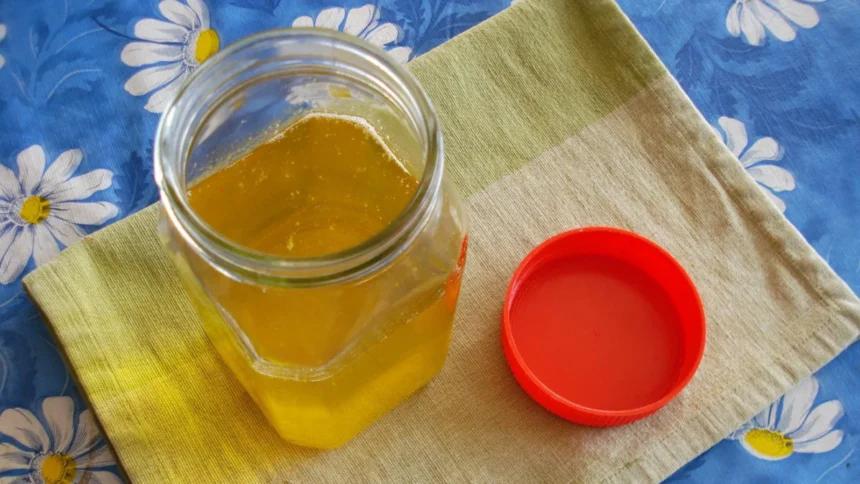
Ghee, widely cherished in India for its rich flavor and nutritional benefits, is facing increased scrutiny regarding its purity. The Food Safety and Standards Authority of India (FSSAI) has shared a straightforward home-based test to detect adulteration in ghee.
Understanding Adulterated Ghee and Detection Methods
Adulterated ghee is a product mixed with cheaper oils, fats, or other substances, compromising its quality and potentially posing health risks. The FSSAI recommends a practical method to verify the authenticity of your ghee.
The test involves placing 1 ml of melted ghee into a test tube, followed by the addition of 1 ml of concentrated hydrochloric acid (HCl). Subsequently, half a teaspoon of sugar is added, and the mixture is vigorously shaken for at least two minutes. The mixture is then left to separate.
While pure ghee shows no color change, adulterated ghee will exhibit a coral red or pink color in the acid layer. This color change occurs because hydrochloric acid breaks down sugar molecules to form furfural, which then reacts with phenols present in substances like vanaspati or sesame oil, producing the red or pink hue.
In a social media post, FSSAI stated, “Ghee is a part of almost every Indian household. But have you ever wondered if the Ghee you’re using is adulterated with Vanaspati or hydrogenated edible fat? Watch this video for a simple test you can try at home to find out! Stay informed, stay safe!”
Ghee is a part of almost every Indian household. But have you ever wondered if the Ghee you’re using is adulterated with Vanaspati or hydrogenated edible fat?
Watch this video for a simple test you can try at home to find out!Stay informed, stay safe!#FSSAI#NotoAdulterationpic.twitter.com/13F3Ivt5Yr
— FSSAI (@fssaiindia) June 20, 2026
FSSAI Seizes Over 6,500 Liters of Adulterated Ghee
In a significant development, FSSAI recently busted a large interstate network involved in the production and distribution of counterfeit ghee. The investigation was a collaborative effort between the FSSAI Northern Regional Office, local police, and central food safety authorities.
During the operation, samples collected from various locations revealed that the ghee contained a mixture of vegetable oils and other non-milk-fat substances instead of pure ghee. Authorities in Delhi raided a facility near Dwarka, seizing approximately 1,500 liters of suspected adulterated ghee. In Haryana, over 4,000 liters of suspicious adulterated ghee, packaged for market distribution, were discovered.
For more details on this case, click here to read the full report.