

The outgoing UN Special Rapporteur on the situation of human rights in Myanmar, Tom Andrews, has issued a stark warning to the international community, urging renewed efforts to protect civilians and support the beleaguered population. Presenting his final report to the UN Human Rights Council in Geneva, Andrews highlighted the precarious state of human rights in Myanmar amidst a challenging geopolitical climate.
“The current geopolitical climate is less than conducive to advancing human rights in Myanmar and beyond,” he stated. “The United Nations and the principles on which it was founded more than 80 years ago are under severe strain.” Andrews cautioned that diminishing international pressure and shrinking humanitarian funding could lead to devastating consequences for a population already enduring widespread violence and deprivation.
“Actions by the international community to weaken the military junta’s ability to sustain itself and its attacks on the people of Myanmar have shown promise,” he added. “Alarmingly, however, there are signs that the resolve of governments is waning.”
The Human Cost of the Coup
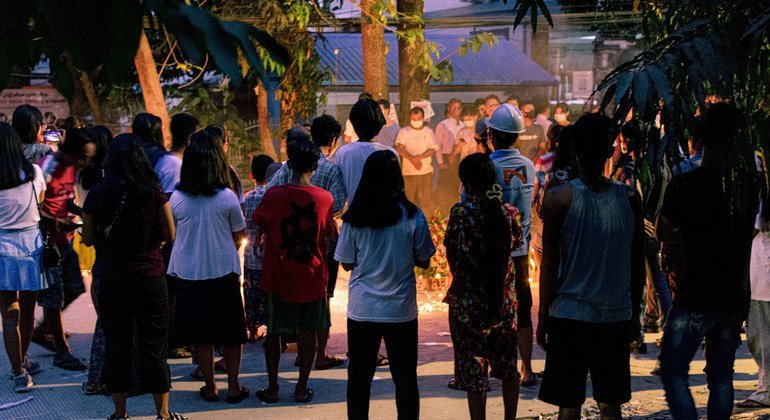
Myanmar has been embroiled in conflict since the military’s seizure of power in February 2021, which led to the overthrow of the civilian government and the arrest of its leaders. The coup ignited nationwide protests and subsequent armed resistance, with these movements now controlling significant areas of the country.
Violence against civilians has escalated dramatically, with a surge in airstrikes on civilian targets from nine in 2021 to 1,140 in the past year. The use of landmines by junta forces has also increased sharply, leaving communities in a state of constant fear, and over 100,000 homes have been destroyed.
A Deepening Humanitarian Crisis
The ongoing conflict has exacerbated a severe humanitarian emergency. According to the UN Office for the Coordination of Humanitarian Affairs (OCHA), nearly a third of Myanmar’s population requires humanitarian assistance, and over 12 million people are facing acute hunger. More than 3.6 million people are displaced nationwide as fighting intensifies in regions like Sagaing, Magway, Chin, Bago, and Kayin.
Civilian casualties continue to rise. The UN Human Rights Office (OHCHR) reports that airstrikes attributed to Myanmar’s armed forces killed at least 982 civilians in 2025, a 53% increase from the previous year, including 287 children. In Rakhine State alone, aerial attacks resulted in over 190 deaths and the destruction of homes, medical facilities, and displacement camps.
A Call for Decisive Action
Despite the deteriorating situation, Andrews emphasized that international measures aimed at isolating the military leadership have yielded positive results. Sanctions on military-controlled businesses and arms networks have hampered the junta’s access to weaponry, and the regime has struggled to attain international legitimacy.
“Will it bring to scale measures that have proven to be effective and support the people of Myanmar who continue to demonstrate remarkable courage and tenacity?” Andrews questioned. “Or will it retreat and abandon the people of Myanmar precisely when they need that support the most?” He stressed that the international community stands at a critical juncture, facing a choice between scaling up effective measures and providing vital support, or withdrawing and leaving the people of Myanmar vulnerable.