

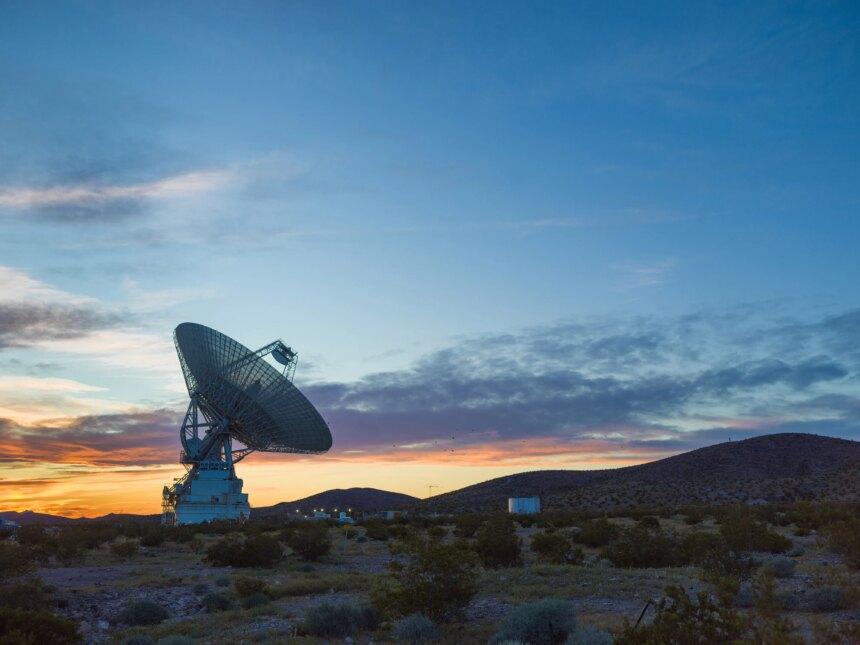
NASA has concluded its investigation into the incident that damaged the 70-meter Deep Space Station 14 (DSS-14) antenna at the Goldstone Deep Space Communications Complex in California last year. The agency has officially classified the event as a Type A mishap due to the significant repair costs. The antenna will remain offline for an extended period as repairs are completed and scheduled upgrades are implemented.
“NASA takes safety and any departure from established procedures seriously, and the investigation at Goldstone made clear that we must strengthen our processes. We are acting on the investigation’s findings,” stated Joel Montalbano, acting associate administrator for NASA’s Space Operations Mission Directorate. “We will update and improve procedures, rebuild core in-house capabilities, and reinforce operational discipline across the Deep Space Network. NASA remains focused on learning from this and modernizing systems, so DSS-14 and the broader network are ready to support our ambitious future missions.”
The incident occurred on September 16, 2025, when the DSS-14 antenna experienced an over-rotation while tracking NASA’s Juno mission. This excessive stress damaged critical cabling and structural supports. Water lines connected to the antenna’s fire suppression system were also compromised, leading to substantial flooding within the facility. Fortunately, no personnel were injured during the event.
A dedicated Mishap Investigation Board, comprising experts from across NASA, was assembled to thoroughly examine the technical, organizational, and cultural factors contributing to the incident. The board conducted on-site inspections, interviewed relevant personnel, and meticulously reviewed technical documentation and operational logs from all three Deep Space Network sites. The final report was completed in April and submitted for agency approval.
The investigation yielded several findings and recommendations that highlight the importance of enhanced training, technical precision, updated operational procedures, robust system design, clearly defined roles and responsibilities, and rigorous safety assurance. Concurrently, teams are already implementing the lessons learned across all network locations to foster greater operational consistency and reduce the likelihood of future mishaps.
The board’s final report identified software vulnerabilities, human error, and a failure in the antenna’s hydraulic limit system as primary causes of the mishap. Investigators determined that an electrical issue the day prior caused the control system to inaccurately report the antenna’s rotational status. This undetected issue led to multiple limit-stop activations during the Juno tracking session. While attempting to resolve the limit-stop problem, operators inadvertently bypassed critical software and hardware safeguards through troubleshooting steps, ultimately resulting in the over-rotation. Following the discovery of flooding, operators tried to stow the antenna as a safety measure. However, as the system had already exceeded its rotation limits, this action exacerbated the over-rotation and caused further damage.
Furthermore, the investigation revealed that the antenna’s hydraulic limit system, its final mechanical safety mechanism, was non-operational on the day of the incident. This was due to damage sustained in a prior, undocumented incident, and the system had not undergone adequate testing for an extended period.
Investigators also concluded that a workplace culture prioritizing speed, often compelling operators to exceed their defined roles, expertise, and training, contributed to the incident. The report noted that these specific cultural conditions were not observed at the other Deep Space Network sites, where roles and responsibilities are more consistently adhered to. Additional contributing factors identified include inadequate procedures, reliance on undocumented practices and implicit knowledge, and deficiencies in the antenna’s control logic. NASA has accepted this report as final.
The estimated cost for repairs ranges from $4.1 to $4.6 million, with the final figure to be determined after a comprehensive assessment of the antenna’s systems. The DSS-14 antenna will remain offline as it undergoes its previously scheduled extended maintenance and upgrade period, initially slated to begin in August and concluding around October 2028. These upgrades are part of a larger initiative to enhance the Deep Space Network, crucial for supporting future exploration and scientific missions, as well as bolstering national planetary defense capabilities.
“We are committed to learning everything we can from this incident, and we’ve already begun putting those lessons into practice,” said Kevin Coggins, deputy associate administrator for NASA’s SCaN (Space Communications and Navigation) Program. “Our teams are working to strengthen and standardize processes and training across all three network sites to ensure it remains resilient, consistent, and ready to support the next generation of missions. Every challenge is an opportunity to improve, and this is no exception.”
Despite the DSS-14 incident, the Deep Space Network continues to provide uninterrupted coverage for over 40 active missions. The network’s 13 other antennas, located at complexes in California, Australia, and Spain, are fulfilling all tracking requirements without interruption. A specialized scheduling team manages antenna time allocation across the network to meet the scientific and data-return objectives of each mission, ensuring continuous coverage even during antenna maintenance or unexpected outages.
The full report, including redactions for proprietary and privacy-sensitive information, is available here: https://www.nasa.gov/wp-content/uploads/2026/06/dss14-mishap-investigation-board-report-signed-final-redacted-hm-tagged-508.pdf?emrc=74c749