

New maps derived from NASA’s Black Marble data are offering a more detailed look at how artificial light at night is changing across the globe. Contrary to a simple, steady increase, the analysis reveals a dynamic planet experiencing fluctuations in nighttime illumination, reflecting industrial activity, construction, power outages, and policy-driven changes.
The Black Marble product utilizes data from the VIIRS sensors aboard the Suomi-NPP, NOAA-20, and NOAA-21 satellites. The VIIRS day-night band captures nighttime light across various wavelengths, enabling the detection of signals like city lights, moonlight, and auroras, and producing daily, monthly, and yearly records.
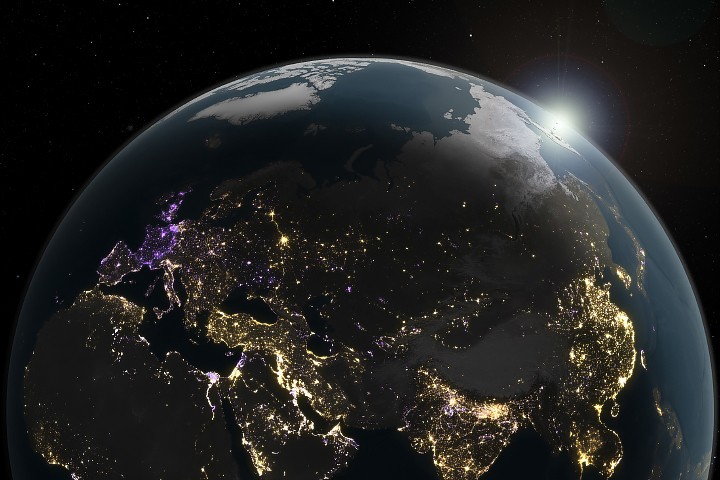
The maps illustrate changes in brightness between 2014 and 2022 across most inhabited regions (60 degrees south to 70 degrees north latitude). Areas shown in yellow and gold indicate an increase in brightness, while purple areas signify a decrease.
Researchers observed a global radiance increase of 34 percent during the study period. However, this overall surge masks significant regional dimming. In the U.S., for instance, West Coast cities brightened with population growth, while the East Coast experienced dimming attributed to the adoption of energy-efficient LEDs and economic shifts.
Internationally, nighttime light intensified in China and northern India, correlating with urban development. Conversely, energy conservation measures and LED adoption led to reduced light pollution in Paris and France (33 percent dimming), the UK (22 percent dimming), and the Netherlands (21 percent dimming). European nights significantly dimmed in 2022 amid an energy crisis linked to the Russia-Ukraine conflict.
The study, published in Nature in April 2026, provides a nuanced view of Earth’s evolving nighttime landscape. Animations detailing annual changes are available from NASA’s Scientific Visualization Studio.