

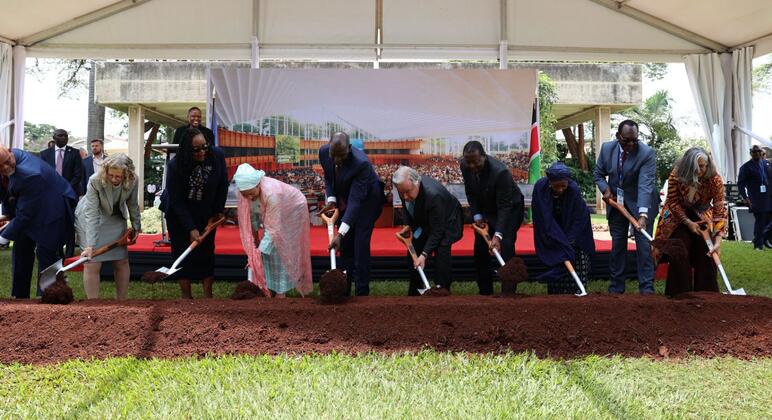
The United Nations has inaugurated new office buildings and broken ground on a new conference facility at the UN Office at Nairobi (UNON), marking a substantial expansion of its operations in Africa. The $340 million project, approved by the UN General Assembly, represents the largest investment by the UN Secretariat on the continent in its 80-year history, reinforcing Nairobi’s position as a key hub for international diplomacy.
UN Secretary-General António Guterres hailed the expansion as a “vote of confidence in Africa’s place at the heart of international cooperation.” He emphasized that the new facilities are more than just buildings, signifying a commitment to bringing the UN’s work closer to the people it serves and better equipped to support regional solutions.
Enhanced Conference Capacity and Global Reach
The expansion will significantly increase UNON’s conference capacity from 2,000 to 9,000 participants. This includes the construction of a new assembly hall and upgraded meeting facilities. Guterres stated that this development aligns with the UN’s broader strategy to be more connected to the realities of regions most impacted by global challenges.
Nairobi: A Pillar in the Global South
Speaking at the event, Secretary-General Guterres described Nairobi not as an outpost, but as a “pillar” and the sole UN headquarters in Africa and the Global South. The Gigiri complex, initially established in the 1970s for the UN Environment Programme (UNEP) and the UN Human Settlements Programme (UN-Habitat), has evolved into a major operational center supporting numerous UN offices and programs across Africa and beyond, hosting thousands of staff.
Guterres acknowledged Kenya’s significant contribution, noting that the land for the Gigiri campus was donated by the Kenyan Government, expressing gratitude for the “enormous generosity and hospitality” of the nation.
Sustainable and Accessible Infrastructure
The newly opened office buildings are UNON’s first net-zero facilities, utilizing on-site solar energy for year-round power. Further solar installations planned for the conference expansion aim to bring the complex close to energy neutrality by 2030. The project also incorporates the planting of approximately 6,000 indigenous trees and universal accessibility features across the campus.
Urgent Calls for Global Reform
Beyond infrastructure, Guterres used the occasion to renew his calls for reforms in international governance and financial systems, highlighting persistent structural inequalities in Africa stemming from historical contexts. He described the current situation as “deeply unfair,” citing high borrowing costs for many African nations despite their economic potential.
The Secretary-General reiterated his long-standing advocacy for permanent African representation on the UN Security Council and increased influence for African countries within international financial institutions. “There will be no justice before there will be permanent African members in the Security Council,” he asserted.
Africa as a Driver of Solutions
Guterres argued that many global institutions, established in 1945 without African input, perpetuate outdated power structures. He characterized Africa as “a driver of solutions, a source of innovation, and a voice of moral clarity,” but noted that the continent’s potential is hindered by an “unequal international system that reflects last century’s power relations.”