

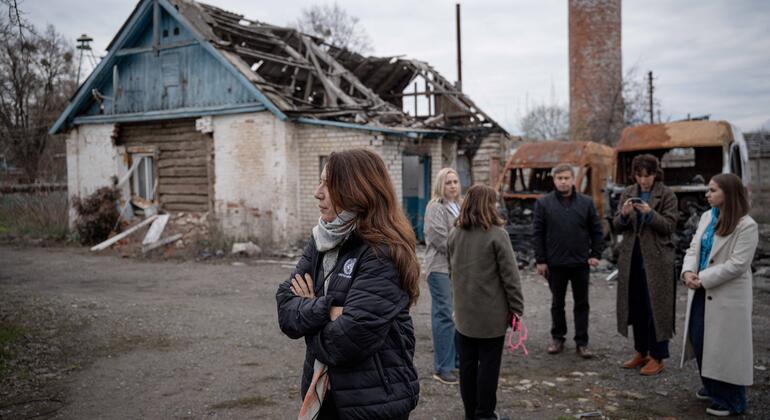
Vanessa Frazier, the UN Secretary-General’s Special Representative for Children and Armed Conflict, has detailed the devastating effects of the ongoing war on children following recent visits to Ukraine and the Russian Federation. Frazier expressed particular concern over disruptions to education and the significant psychosocial impacts on young people.
War’s Toll on Children
During her visit to Ukraine, Frazier observed that children are disproportionately affected by the conflict, with education suffering a severe blow. She noted that children, already adapting to online learning post-COVID-19 pandemic, are now facing an additional four years of this mode of education due to the war. The Ukrainian government, with support from UNICEF and NGOs, is striving to maintain educational continuity through creative solutions like underground and metro schools.
In the Russian Federation, Frazier recalled that Russian armed forces are listed for six grave violations identified by the UN Security Council, including the killing and maiming of children and attacks on schools and hospitals. She stated that the only way to be removed from this list is to enter into a time-bound commitment plan with the UN.
Furthermore, she addressed the General Assembly’s resolution on deported Ukrainian children, discussing their situation with the Russian Federation. Frazier confirmed that access to some Ukrainian children within Russian territory has been granted, and the city of Belgorod was also visited.
Psychosocial Impact and Protection Measures
Frazier highlighted the particularly precarious situation in frontline areas of Ukraine, where children in places like Kharkiv and Zolochiv live under constant sirens. She observed that children are receiving socialization and psychosocial support through metro station schools and child-friendly spaces in shelters. A story that deeply affected her was that of a 12-year-old girl who narrowly escaped death when the spot where she was sitting during an online lesson was struck moments after she moved.
She noted that children with disabilities are always more vulnerable, but expressed hope in Ukrainian projects prioritizing accessibility. Frazier emphasized the need for full integration of accessibility in reconstruction efforts.
During her visit to Belgorod, she sensed the deep cultural and personal ties between the local population and Ukraine, observing intertwined families across the border. This situation, she noted, intensifies the sorrow felt by the people on both sides.
Expectations from the International Community
Frazier commended the joint protection plan implemented in Ukraine for its success in keeping the number of child casualties lower than anticipated. However, she stressed that while both sides focus on protecting their own children, greater emphasis should be placed on protecting each other’s children. She specifically raised concerns about weapons like cluster munitions and landmines that cause civilian casualties.
She underscored the international community’s expectation for increased support for the education sector. Children should not be forced to choose between safety and education, and the establishment of more underground schools is crucial. Education, she stated, is vital not only for helping children cope with trauma but also for building peace.
Frazier reiterated that this war should not be happening and voiced her support for the Secretary-General’s calls for a ceasefire and a negotiated solution. She concluded by stating that children are bearing the devastating consequences of adult decisions, a situation that must end immediately.