

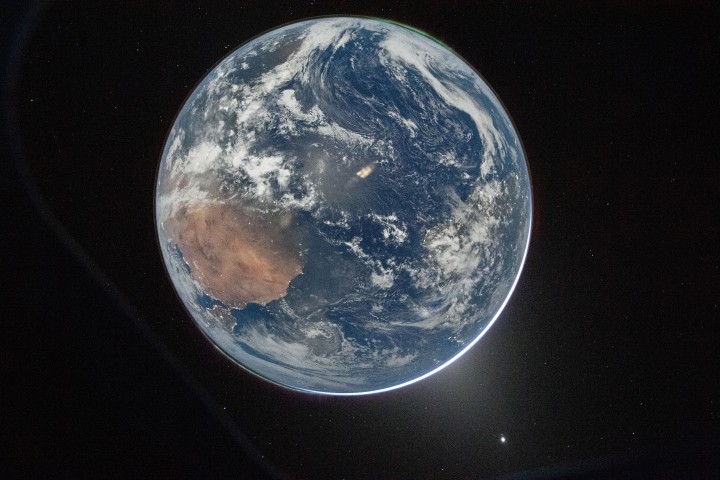
The Artemis II mission has unveiled one of its initial transmissions back to Earth: a captivating image showcasing our planet’s position within the solar system. The photograph features a full view of Earth, with its illuminated hemisphere revealed to be lit not by sunlight, but by moonlight. This image, captured from a unique vantage point by the astronauts, highlights the city lights that signify human activity from a novel perspective.
Taken by a member of the Artemis crew from the Orion spacecraft, the photograph was acquired following the translunar injection maneuver that initiated the craft’s journey from Earth toward the Moon. In the image, as Earth obscures the Sun from Orion’s viewpoint, only a small sliver of bright light remains visible on its lower right edge. Green auroras, resulting from the interaction of charged particles from the Sun with Earth’s upper atmosphere, glow at the polar regions (lower left and upper right).
The glow visible on the lower right side of Earth, caused by the reflection of sunlight, is known as “zodiacal light.” This phenomenon arises from sunlight reflecting off interplanetary dust particles. Observers on Earth can witness this event as a faint column of light rising from the horizon during dawn or twilight at certain times of the year. Data from NASA’s Juno spacecraft during its journey to Jupiter suggests that Mars may be a significant source of the dust particles that create zodiacal light. The bright object in the lower right corner of the image is identified as Venus, Earth’s neighbor.
On Earth, city lights stand out as evidence of human activity. Bright areas are noticeable in Spain, Portugal, and North Africa (lower left), Sub-Saharan Africa (mid-left), and Brazil (mid-right). With the aid of full moonlight, digital camera technology enabled the visibility of these and similar night-time details in low light. The crew increased the camera’s ISO setting to 51,200 to enhance its light sensitivity. For comparison, ISO settings of 100 or 200 are typically used for daytime photography.
While previous night views of Earth from spacecraft have differed from this photograph, they have been both inspirational and illuminating. For instance, the Apollo 12 crew photographed Earth occulting the Sun in 1969; astronaut Alan Bean later depicted his impressions of this event in his paintings.
More recently, astronauts aboard the International Space Station have photographed the planet at night from low Earth orbit. NASA’s Black Marble night lights product suite generates scientific-quality night light records on daily, monthly, and annual scales using satellite observations. While these programs provide continuous data records, the Artemis II photograph stands out as a single, human-captured full-disk image showcasing numerous low-light features simultaneously.
Lead researcher Cindy Evans from NASA’s Johnson Space Center was in the Science Evaluation Room during the Artemis II mission and was among the first to see the image. Evans expressed her awe at both the image’s beauty and the perspective offered by all the solar system features visible. “I love the image so much that I was mesmerized by the fact that it was taken in moonlight and shows Earth as a dynamic planet, a solar system body interacting with the solar wind, and a place that harbors life,” she stated.
Miguel Román, Deputy Director for Atmospheres and Data Systems at Goddard Space Flight Center, noted the image’s scientific value. “It powerfully tells the story of the breadth of NASA’s work in science and human exploration,” Román said. Román studies the nighttime artificial lights seen from space as a measurable signal of human activity.
Román added, “[This photograph] reminds us that Earth’s night is visually stunning, physically complex, and scientifically underexplored. I see this image as a preview of what Earth science could be in the future.”
NASA visuals were prepared by Lauren Dauphin for Earth Observatory. The story was written by Lindsey Doermann.