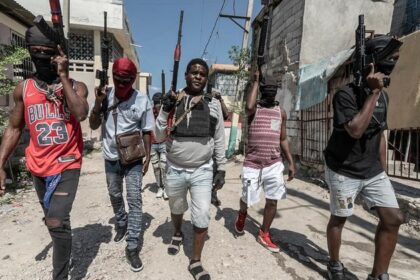


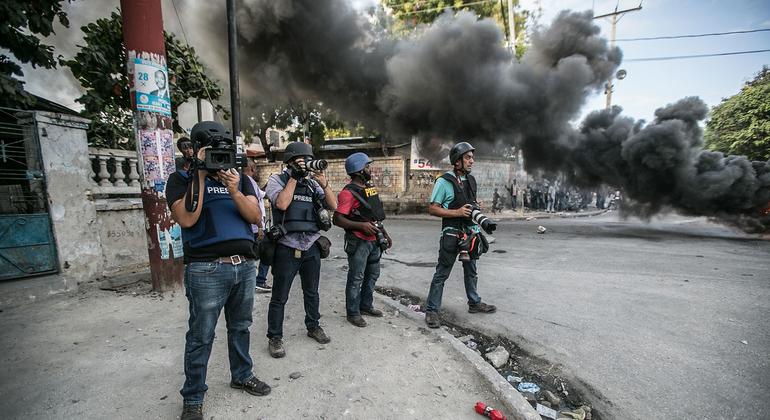
Haiti, a Caribbean island nation, is grappling with pervasive insecurity and escalating poverty. The violence orchestrated by gangs has forced approximately 1.4 million people to abandon their homes. Since 2021, 14 media workers have been killed in Haiti, according to UNESCO’s Observatory of Killed Journalists. In the lead-up to World Press Freedom Day on May 3, UN News spoke with two journalists operating in the capital, Port-au-Prince, to understand the dire situation.
Jean Daniel Sénat, who works for the daily newspaper Le Nouvelliste and Radio Magik 9, described the current operating environment for journalists as “particularly harsh and restrictive, characterized by security challenges.” Gangs now hold sway over more than 80 percent of the Port-au-Prince metropolitan area.
Oberde H. Charles, an editor for the daily newspaper Le National and Télévision Pacifique, highlighted the severe limitations on movement and communication. “We cannot move around freely. There is little communication between the different departments of the country, and between certain city neighborhoods to which we have restricted access. All of this limits our work as journalists,” Charles stated.
Sénat emphasized the inherent risks of the profession: “Our job is to go out into the field to gather information, to search for first-hand sources, to speak to witnesses, to tell stories. This is very challenging because we are constantly under threat from criminal groups.” He further noted that journalists sometimes face threats from the police, who may suspect them of collaborating with gangs due to their ability to access gang-controlled areas. Conversely, criminal groups sometimes believe journalists are informing the police.
The dangers are starkly illustrated by recent events. Oberde H. Charles reported that “Recently, two fellow journalists were abducted.” He also recalled an incident in 2022 during street protests by textile workers, where police gunfire resulted in injuries and the death of a journalist colleague.
Jean Daniel Sénat shared the broader impact: “Several dozen journalists have been killed. Some have been kidnapped, and others have had to flee the country and live in exile because of threats from criminal groups.” He revealed personal experiences, stating, “Personally, I have had to move home twice because of insecurity.” Sénat also mentioned that Le Nouvelliste lost its headquarters in February 2024, and Radio Magik 9 had to relocate due to gang advancements. He spoke of colleagues who survived assassination attempts, some who are missing, and others who remain hospitalized.
Oberde H. Charles observed that “many fellow journalists have decided to leave the country” for safety in Canada, France, or the United States, deeming it the “best decision” for self-preservation and for their loved ones. He praised those who continue to work in Haiti as “brave, truly brave.”
The erosion of the media landscape is evident as “Some radio stations have simply stopped broadcasting,” according to Sénat. He added that some journalists have lost their jobs and others bear the “physical scars of gang violence,” citing examples of colleagues who lost an eye, were shot in the leg, or are still hospitalized. Beyond physical harm, journalists also endure significant emotional trauma.
Charles drew a stark comparison, stating, “Our country is not at war with another State, but there is a war. And this war is far more terrible and far more deadly than what is happening in Israel or in Ukraine.”
Despite the immense risks, Sénat stressed the vital role of journalism: “At the end of the day, we tell ourselves that if we do not document, if we do not inform, if we do not seek out information, then it is the population that will pay the price.” He emphasized that a strong media is essential for conveying the truth and enabling external understanding of Haiti’s complex situation.
Charles concluded by underscoring Haiti’s need for a robust and objective media that provides truthful information. “The absence of information can put democracy and thus individual freedom in danger,” he warned.