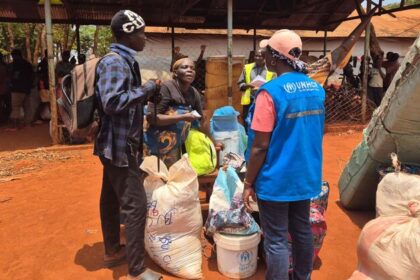


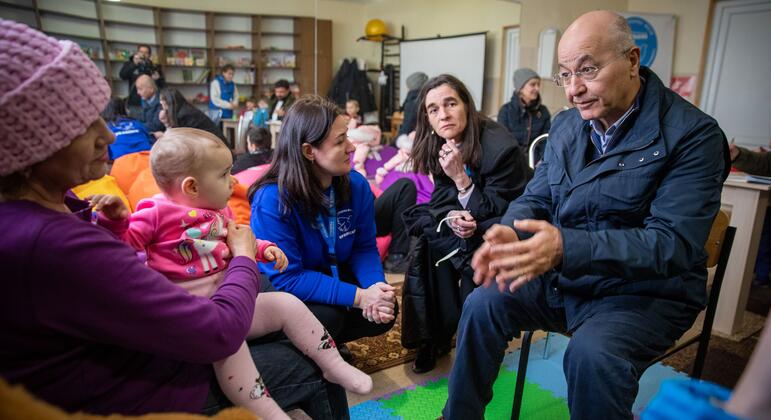
Newly appointed UN High Commissioner for Refugees, Mr. Salih, has immediately immersed himself in the field, visiting refugee camps in Kenya and Chad within days of taking office. This proactive approach signals his intention to lead an agency facing unprecedented challenges due to rapidly multiplying crises.
“The responsibility in every sense of the word is awesome,” Mr. Salih stated in a recent interview, acknowledging the immense scale of the task ahead.
For Mr. Salih, who is in his mid-sixties, the role is deeply personal. Having experienced displacement as a teenager, he understands the plight of refugees not as abstract statistics but as lived realities.
‘Behind Every Statistic Is a Life’
Born in Iraqi Kurdistan in 1960, Mr. Salih became a refugee during his teenage years, spending years in exile under Saddam Hussein’s regime. He pursued his education in the United Kingdom, built a political career, and eventually returned to Iraq, serving as the country’s eighth president in 2018. This unique trajectory now informs his perspective on the millions of people currently displaced.
“Behind every statistic is a life,” he emphasized, “a person with aspiration, with a right to dignity, with the right to a better future.”
This focus on individual dignity has been a consistent theme in his early months. However, he also confronts the stark reality that the global system designed to address displacement is under severe strain. Despite rising displacement figures, humanitarian funding is decreasing, forcing organizations like UNHCR to stretch limited resources across escalating needs.
A Crisis Without End
For decades, the framework for refugee protection operated under the assumption that displacement was temporary. Refugees were expected to find safety, receive protection, and eventually return home once conditions allowed.
“Being a refugee is not meant to be a fate,” Mr. Salih asserted. “It is meant to be a temporary condition.”
However, prolonged conflicts and stalled political resolutions have fundamentally altered this premise. Currently, nearly two-thirds of refugees are experiencing what humanitarian agencies term “protracted displacement,” living for five, 10, or even 20 years or more without a lasting solution. Entire generations are growing up in camps, never having known the homes their families fled.
The UN refugee chief does not shy away from the gravity of the situation.
“That is not an acceptable situation,” he declared. “This is a violation of the basic human rights to dignity.”
Ambitious Plan for Long-Term Solutions
Mr. Salih has outlined an ambitious goal: to halve the number of people in long-term displacement dependent on humanitarian aid within a decade. He recognizes that this target extends beyond the current capacity and resources of UNHCR alone.
“I know, and I understand full well, that this is far beyond the means and the capabilities of UNHCR today,” he admitted.
His strategy relies on achieving greater economic inclusion for refugees, an area where the humanitarian system has historically struggled. Mr. Salih advocates for empowering refugees to work and contribute to their host societies, thereby reducing dependency on aid.
This approach necessitates a broad coalition involving development banks, private investors, donor governments, and host countries, many of which are themselves facing economic pressures. It also requires a shift in political will, particularly as some wealthier nations are increasingly restricting borders rather than opening opportunities.
The Burden on Host Nations
A significant challenge in the refugee crisis is that the primary burden often falls on countries least equipped to manage it.
“We need to help host nations who are mostly, by the way, low-income, middle-income countries,” Mr. Salih stated.
From Colombia to Uganda, Chad to Bangladesh, these nations host the vast majority of displaced individuals, frequently with inadequate international support. Their infrastructure, including schools and hospitals, and labor markets are stretched thin to accommodate newcomers, even as their own citizens grapple with economic hardship.
The UN refugee chief expresses both admiration and a sense of urgency regarding these host communities.
“I am humbled by the generosity of many of these host nations and communities,” he said.
However, he cautions that generosity has its limits. Without sustained investment and integration policies, the system risks becoming a permanent crisis, with displaced populations being warehoused rather than genuinely welcomed.
A Message of Resilience and Agency
During his visits to places like Kakuma refugee camp in Kenya and Turkish cities hosting Syrian refugees, Mr. Salih has witnessed a profound resilience that defies despair.
“The story of resilience with every refugee I have met is genuine and is real,” he affirmed.
This resilience forms the core of his message, especially for young refugees facing uncertain futures.
“To the young people, I say we are going to be working to help you with your agency,” he stated, highlighting not just protection but the empowerment of refugees to shape their own destinies.
The emphasis on “agency” signifies a move away from viewing refugees solely as victims, towards recognizing them as active participants in their futures. It also places a responsibility on the international community to foster an environment where this agency can be realized.
“A refugee is meant to be a temporary situation, not a permanent pain.”
Currently, the conditions enabling this agency remain precarious. Conflicts persist, humanitarian budgets are shrinking, political consensus is eroding, and the number of displaced people continues to rise, each individual representing, as Mr. Salih stresses, an interrupted life.
Reflecting on his initial travels, Mr. Salih was struck not only by the scale of the crisis but by its enduring nature. He reiterated the central idea framing his mission: “Once again, a refugee is meant to be a temporary situation, not a permanent pain.” For millions living in refugee camps, this distinction has already become blurred.