

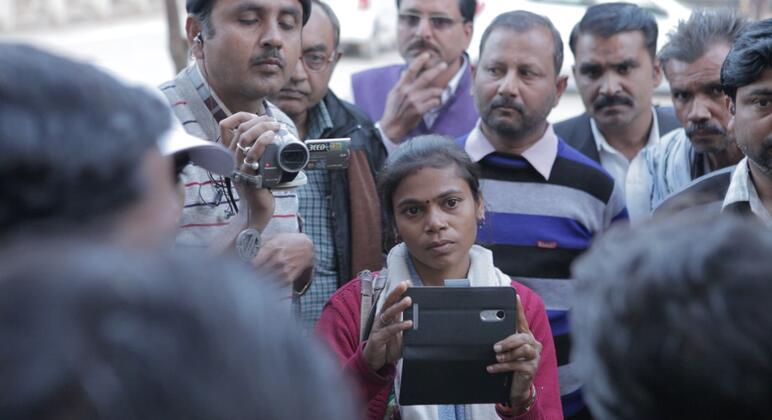
Khabar Lahariya, meaning “news waves,” has been an all-women media organization since 2002, driven by rural reporters, many from Dalit, Adivasi, and Muslim communities. They deliver fresh stories from some of India’s most marginalized regions.
“We faced challenges at every level,” founder Kavita Devi told UN News. “People would say women can’t be journalists, but we went to villages, persisted and proved that women can not only report but tell stories that others cannot.” These women were building their own diverse newsrooms long before global conversations about diversity entered mainstream media.
From Illiterate to Multimedia Producers
Initially, villagers doubted women’s capabilities as journalists, and educational barriers made recruiting reporters a significant hurdle, Ms. Devi recalled. At the time, female reporters were almost non-existent in newsrooms across Uttar Pradesh and Bihar. Many women who joined Khabar Lahariya had limited formal education.
One such journalist, Shyamkali, transformed from being illiterate to becoming a senior reporter.
Reporting from the Margins
“I didn’t know how to write a resume or handle a camera, but with training and guidance, I was able to learn everything, from interviewing to mobile journalism, and now I report stories that mainstream media ignore,” Shyamkali told UN News. Khabar Lahariya’s reporting goes beyond mere representation.
Shyamkali recounted a story about a woman driven to desperation who acted violently against her abusive husband. Mainstream media reported the incident without context, focusing solely on the shocking act. However, Shyamkali’s reporting brought the woman’s perspective and underlying social realities to light, demonstrating how women journalists add nuance, empathy, and depth to stories often ignored or misrepresented.
Women ‘See Their Own Image in the News’
Language is crucial to Khabar Lahariya’s mission. Publishing in local dialects such as Bundeli, Awadhi, and Bhojpuri ensures news is accessible, relatable, and empowering for rural communities. “When we explain issues in their language, people understand better,” Ms. Devi said. “They see their own image in the news, especially women.”
Game-Changing Digital Media
The transition from print to digital platforms has been transformative for Khabar Lahariya. Its staff embraced mobile journalism, learning to anchor, produce, and share news on social media platforms like Facebook, YouTube, and Instagram.
Technology has empowered us to amplify voices from communities that were always ignored.
“Technology has empowered us to amplify voices from communities that were always ignored,” Shyamkali said, recalling the initial fear and excitement of adopting digital media. “I never imagined handling a camera or sending live reports from a phone, but now I can.” This digital expansion not only increases visibility but also enhances women’s agency, confidence, and economic independence, proving that technology and training can transform social realities at the grassroots level.
Telling the Whole Story
Women remain underrepresented in media, appearing as subjects and sources only one in four times, according to the 2025 Global Media Monitoring Project (GMMP) report. Kalliopi Mingeirou, chief of UN Women’s section to end violence against women and girls, told UN News that this is not due to a lack of expertise or leadership among women. Instead, media outlets often rely on a narrow range of voices, defaulting to men as experts and decision-makers.
When women’s voices are missing, the public is denied half the story.
“When women’s voices are missing, the public is denied half the story,” she stated. “This distorts reality, weakens accountability, and narrows the democratic space. In today’s context of backlash against gender equality, the exclusion of women in news is not only a gender issue, it is a democratic deficit.”
‘Radical Rethink’ Required
Progress in gender representation in media has stalled and is under threat, according to the report. “These findings are both a wake-up call and a call to action,” said Kirsi Madi, Deputy Executive Director of UN Women. “When women are missing, democracy is incomplete.” Despite making up half the world’s population, women constitute only 26 percent of news subjects and sources globally, a figure that has seen minimal change over the past 15 years.
“A radical rethink is needed so that media can play its role in advancing equality,” Ms. Madi urged. “Without women’s voices, there is no full story, no fair democracy, no lasting security, and no shared future.”