

In mid-April 2026, Super Typhoon Sinlaku traversed the North Pacific Ocean, bringing significant rainfall and flooding to the Mariana Islands. The storm reached “violent typhoon” status, the highest intensity on the Japan Meteorological Agency’s scale, comparable to a Category 5 on the Saffir-Simpson wind scale. Meteorologists noted that Sinlaku was among a rare few tropical cyclones of such intensity recorded so early in the year in the region.
Sinlaku underwent rapid intensification over the ocean before its effects reached land. During this strengthening phase, satellites detected the typhoon’s influence extending into the upper atmosphere.
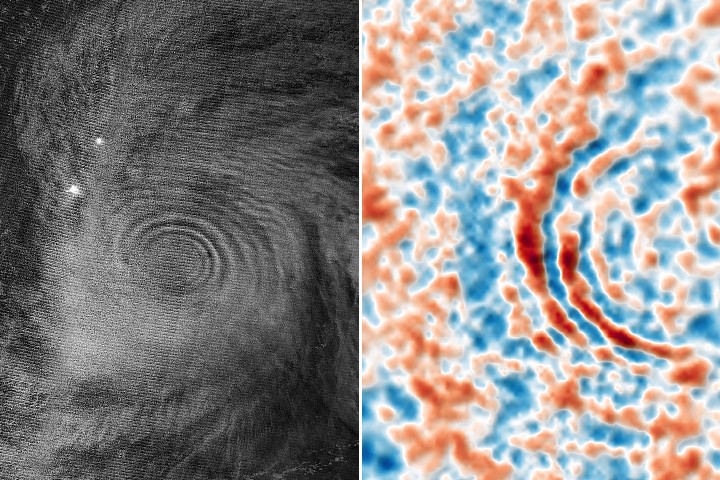
A nighttime image captured by the VIIRS instrument on the NOAA-20 satellite revealed atmospheric gravity waves emanating from the typhoon. These waves, appearing like ripples on water, were made visible through airglow in the mesosphere. Airglow occurs when atmospheric atoms and molecules, energized by sunlight, emit light as they release excess energy.
The release of latent heat near the eyewalls of tropical cyclones is known to fuel convection and the formation of towering cumulonimbus clouds. These “hot towers” can ascend beyond the troposphere, the atmosphere’s lowest layer, generating waves that propagate into the stratosphere and mesosphere. Analysis of past tropical cyclones indicates that gravity waves frequently appear during storm intensification. In the 24 hours preceding the satellite image acquisition, Sinlaku had intensified from a Category 2 to a Category 5 storm.
“We’re seeing waves propagating radially and upward, in a cone-like shape,” stated Joan Alexander, a senior research scientist at NorthWest Research Associates. Alexander expressed surprise at observing nearly complete rings in the mesospheric airglow above the storm. While upper-atmosphere winds can typically dissipate such waves before they reach high altitudes, relatively light stratospheric winds at Sinlaku’s latitude in April 2026 may have contributed to their preservation.
The low level of moonlight during the observation period was also advantageous. The VIIRS day-night band is sensitive to mesospheric airglow but also detects reflected moonlight. With the Moon only about 25 percent illuminated on April 12, some light reflected off tropospheric clouds was visible but did not overpower the airglow signal.
Sinlaku’s gravity waves were observed both high in the atmosphere via airglow and lower down by the AIRS instrument on NASA’s Aqua satellite. An image depicting thermal emissions from gravity waves in the stratosphere on April 13 showed a rippling pattern that persisted in April 14 observations, indicating the storm’s ongoing atmospheric impact.
Observing atmospheric gravity waves, especially those generated by tropical cyclones, has practical applications beyond scientific interest, including the potential for improved storm development monitoring. Alexander noted, “We’d like to use gravity waves to tell us if a storm is intensifying, which can be difficult to know, especially over the open ocean.” She and her colleagues have proposed that a geostationary satellite equipped with a suitable infrared imager could observe gravity waves and track tropical cyclone evolution.
Furthermore, Laura Holt, also a senior research scientist at NorthWest Research Associates, emphasized the importance of incorporating stratospheric processes into weather models. Stratospheric wind patterns influence long-term forecasts for the Northern Hemisphere winter, and tropical cyclones exert a significant effect due to their sustained, intense convection driving prolonged gravity wave forcing of the stratosphere.
The influence of gravity waves extends even to space weather. Holt mentioned that “people have seen signatures of hurricanes in ionospheric weather” for some time. Gravity waves can cause traveling ionospheric disturbances and, in some instances, plasma bubbles, both of which can interfere with satellite signals and radio communications. Holt added, “With space weather in particular, a single event such as a tropical cyclone can be very important.”