

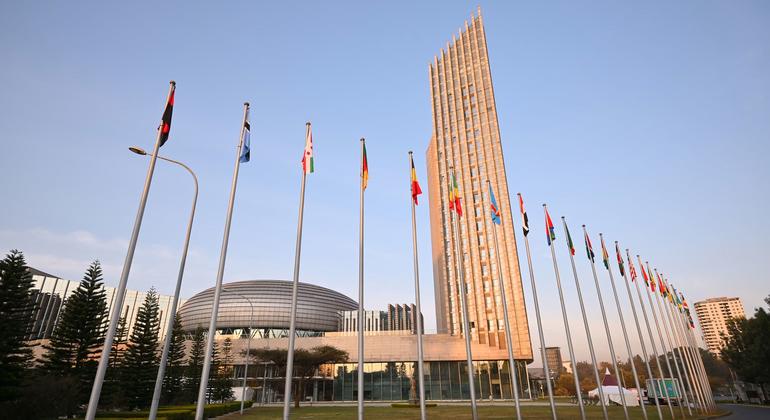
United Nations Secretary-General António Guterres met with AU Commission Chairperson Mahmoud Ali Youssouf in Addis Ababa to bolster cooperation in peace, security, sustainable development, and human rights. This AU-UN summit marked what Guterres indicated would likely be his final one as Secretary-General, stating, “This is my final AU-UN Conference as Secretary-General. But the ties between our organizations are stronger than ever – and will remain so.”
The two leaders signed a declaration reinforcing the principles of joint UN-AU frameworks, thereby further institutionalizing their collaboration.
Africa’s Global Role and UN Security Council Reform
Guterres lauded the African Union as a “flagship for multilateralism in Africa” and a “collective voice of justice for the developing world.” He emphasized the continent’s significance and potential, particularly in light of the 2024 Pact for the Future, which highlights the role of regional bodies like the AU.
He strongly advocated for reforms to the UN Security Council to better reflect contemporary global realities. “Africa’s continued exclusion from permanent representation is indeed a historical injustice – and we cannot accept it,” Guterres stated. He stressed that this reform is crucial for the Council’s legitimacy and effectiveness, not merely symbolic.
Addressing Financial Inequalities
The Secretary-General also addressed the deep-seated inequalities within the international financial system, noting that African nations face disproportionately high borrowing costs and limited access to affordable capital. “Today’s global financial architecture is not providing adequate levels of support, nor sufficient voice and participation for Africa,” he observed.
Guterres pointed out that many African countries pay up to three times the benchmark interest rate, diverting essential public funds from crucial sectors like water, sanitation, health, and education. He commended African-led initiatives, such as the African Development Bank’s push for a New African Financial Architecture for Development, which aims to unite African financial institutions. “Africa assumes the leadership in solving African problems,” he remarked.
Climate Action and Energy Investment
Warning that Africa bears the brunt of climate change despite minimal contribution, Guterres declared a temporary overshoot of the 1.5°C temperature limit “inevitable – but not irreversible.” He called for increased adaptation finance and greater investment in Africa’s renewable energy capabilities.
He projected that by 2040, Africa could generate ten times its electricity needs from renewables, while simultaneously providing power to the 600 million Africans currently without access. However, he expressed concern that Africa receives only two percent of global clean energy investment, urging the removal of barriers such as weak grids, high capital costs, and fragile supply chains.
Impact of Middle East Crisis on Africa
In a separate meeting with French President Emmanuel Macron and the AU Commission Chair, Guterres cautioned about Africa’s vulnerability to the global economic repercussions of the Middle East crisis, particularly concerning the Strait of Hormuz. He warned that even an immediate resolution would lead to significant consequences, including reduced growth and increased inflation, while prolonged disruption could heighten the risk of a global recession. These effects, he noted, would be especially severe for African economies already burdened by high debt, energy costs, and difficulties in accessing fertilizers.
Promoting Peace and Security
Peace and security were central to the AU-UN discussions. Guterres affirmed the UN’s strong support for the African Union’s ‘Silencing the Guns’ initiative and the African Humanitarian Agency. He highlighted ongoing cooperation on conflicts in Sudan, South Sudan, the Democratic Republic of the Congo, Libya, and the Sahel.
He urged an immediate ceasefire in Sudan and a renewed dialogue in the Sahel to combat violent extremism and terrorism. “I have always believed that Africa should be seen for what it is: a continent of immense richness and promise,” he concluded.