

American artist Sandy Walker is utilizing his art to address the profound legacy of Hiroshima, as highlighted during a recent visit to the UN Headquarters in New York. Walker presented “My Deepest Desire,” a new publication featuring his ink drawings alongside a fresh translation of Tamiki Hara’s final work.
Hara’s work, published posthumously after his suicide in 1951, is a short story that explores the longing for a more meaningful existence. It intertwines the personal tragedy of his wife’s death with the immense devastation and aftermath of the Hiroshima bombing, creating a narrative that shifts between dream, despair, memory, and survival.
Walker emphasized that art possesses the unique ability to translate historical trauma into a deeply human experience. He described himself as passionate about the Hiroshima bombing, viewing it as a critical justice issue. Encountering Hara’s writing evoked an immediate emotional response in Walker.
“He communicated his personal experience and his effort to make sense out of the experience that he’d been through,” Walker stated, noting the writing’s directness and profound impact, despite its unconventional literary style.
From words to images
When asked about translating such sensitive material into visual art, Walker drew a parallel to Hara’s own work. “How could [Hara] have done it into words? It’s the same thing,” he said. “The visual arts are how I can translate.”
Walker explained that this project developed over several decades. After initially encountering Hara’s writing while researching a performance piece on Hiroshima with his wife, dancer and choreographer Ellen Webb, Walker carried the text for years before the visual concepts emerged.
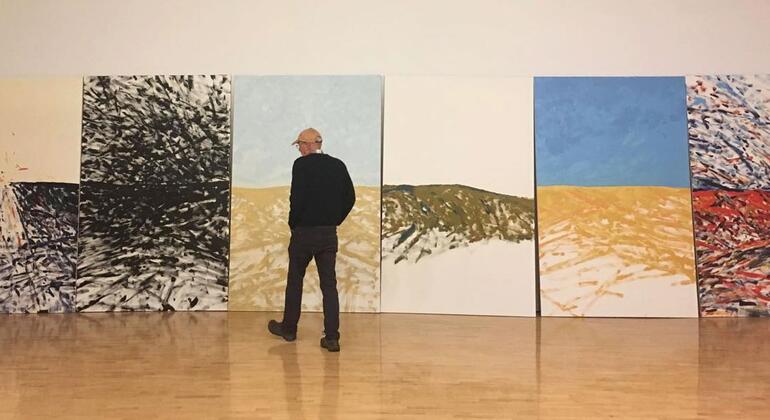
“One dark night I found the images, or I could say they found me,” Walker wrote in the book’s preface, detailing how the series of ink drawings eventually took shape.
He views text and image not as separate entities, but as complementary methods for exploring the same lived reality. Walker suggested that meaning often arises in the space between these two forms of expression, acknowledging the inherent perceptual limits of both painting and writing.
Giving life to absence
Walker’s artistic approach was also shaped by earlier collaborative work, notably the “Shadow Project” initiated with artist Alan Gussow in 1982. This project involved marking human silhouettes in public spaces with white paint, a gesture intended to evoke the outlines of bodies left behind in Hiroshima by the intense heat and blast effects of the atomic bomb.
The project’s aim was to make absence visible within everyday settings through a simple yet conceptually direct action.
“It wasn’t an abstraction,” Walker commented. “It was real, and people could experience it that way.”
The project gained international reach over time, with participants in over a thousand locations recreating the silhouettes annually around the anniversary of the Hiroshima bombing. Walker and Webb also participated in the project within their local community in Washington State’s North Cascades.
“It was a way of bringing that home to people – it was real and they could experience it that way,” he added.
Later, in the late 1980s, after hearing remarks from Paul Tibbets, the pilot of the Enola Gay which dropped the atomic bomb on Hiroshima, the couple created an evening-length performance examining the bombing and its enduring legacy. It was during their research for this performance that Walker first encountered Hara’s writings.
Art as an individual encounter
Throughout the discussion, Walker stressed that art communicates not through collective messages, but through individual experiences. “Art is experienced individually,” he stated. “Then there is a cumulative experience, but it starts with one person.”
In this perspective, the political or historical significance of an artwork is not delivered as a definitive statement but is constructed through sustained attention, with each viewer engaging with the piece on their own terms.
A continuing belief in transformation
When asked about the relevance of such work amidst current global nuclear tensions, Walker responded with a single, powerful word: “Stop.”
He also reaffirmed his enduring belief in art’s capacity to foster change over time through the accumulation of individual experiences. “I have a very strong belief in the arts,” he said. “I still believe in it.”
For Sandy Walker, his work connected to Hiroshima serves not only as a means of remembrance but also as a way to maintain a form of attention that resists abstraction. It insists on recognizing the human scale of historical violence and holds onto the possibility that perception itself can be transformed.