

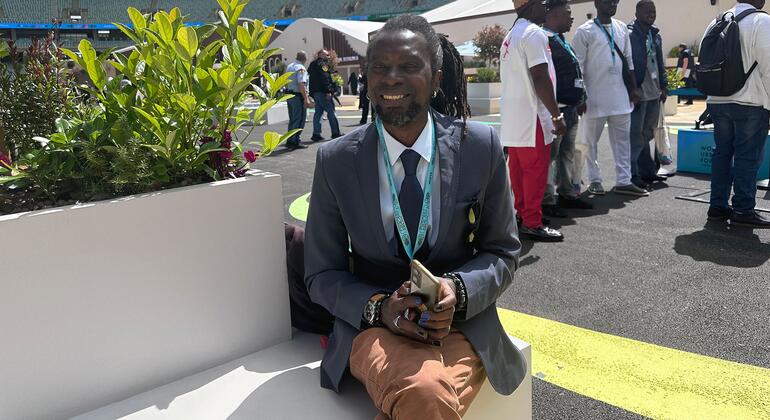
Latyr, a former European Commission employee who once enjoyed a stable middle-class life in Belgium, found himself living in a tent on the streets of Spain for four years due to a fraud investigation. Though eventually cleared, his life was irrevocably altered. Latyr is now sharing his story through the documentary What Nobody Wants to See at the World Urban Forum in Baku.
An Unending Journey
Latyr arrived in Spain expecting to stay only three days. At 40, divorced, and having lost his job at the European Commission, his life took a drastic turn. He was approached by individuals offering what seemed like a legitimate bank transaction and a check. Latyr requested the check be sent directly to his bank in Spain without ever receiving it. However, upon arrival, the check was revealed to be fraudulent.
Authorities, suspecting involvement in a larger criminal network, confiscated his passport, bank cards, and documents. “They told me I had to stay in Spain until the investigation was over; I couldn’t leave the country,” Latyr recounted. He was required to report to a judge monthly to sign in. Despite no border controls, he feared the risk of attempting to flee to another European country.
Life Under the Trees
Choosing to remain in Spain, Latyr gradually descended into homelessness, living on the streets for approximately four years. Unable to work legally without identification, he struggled daily for survival. He discovered a community of homeless individuals who had set up tents under trees in a nearby wooded area and established a precarious existence with them. “We were well-organized where we were. We would buy vegetables, meat, small things to cook. We were trying to build a life,” he described.
To survive, he took on informal jobs, assisting vendors in street markets and transporting fruits and vegetables. Despite degrees in economics and finance, he earned just enough to cover food and basic necessities. “It was about survival,” he summarized.
Illness and a Turning Point
Then came illness. Doctors diagnosed him first with emphysema, then lung cancer. While medical care is available to those in need in Spain, the treatment process was arduous. “The doctor told me if I received chemotherapy while living on the streets, I would die,” Latyr said. He learned that the treatment was too aggressive and that he needed a safe place to rest, eat well, and take regular medication.
This is where HOGAR SÍ intervened. The organization placed Latyr in a shelter called “Espacio Salut” (health space), where he received a bed, food, and support during his chemotherapy. “It saved my life. But it also gave me the opportunity to get out of the streets,” he stated. He began to rebuild slowly. Leveraging his economics and finance background, he started taking on freelance assignments with his laptop. Former contacts and clients in London, France, and the United States began sending him work remotely.
Even years later, he struggles to comprehend how quickly an ordinary life can unravel. “Sometimes, when you fall and you are not mentally very strong, you can make mistakes. And these mistakes can take you very far from reality,” he reflected.
“Four Years of My Life Lost”
The most painful aspect was that after years of investigation, authorities returned his passport and belongings without any explanation. No charges were ever brought against him. “Okay, take your passport, take your laptop. That was it,” he recalled. Four years of his life had been lost.
Today, Latyr speaks publicly about homelessness through the documentary What Nobody Wants to See. His message at the World Urban Forum was directed not only at governments but also at the business sector and housing developers.
A Solvable Crisis
He believes homelessness is a solvable crisis. According to him, there are approximately 37,000 people living on the streets in Spain, a number he considers manageable for a country of 50 million. “If they want to stop it now, they have the means,” he asserted. He pointed to partnerships between non-profit organizations and private real estate companies exploring affordable housing initiatives for vulnerable individuals.
“There is really something that can be done. We just need to think about the right business model and connect all these organizations,” he said. For Latyr, homelessness is not merely a lack of shelter; it is the loss of dignity, identity, and connection to society through a chain of events that can begin much faster than people imagine.